How To Make Money Blogging: A Beginner’s Roadmap From Zero to Your First $1,000
You didn’t search this because you want to be inspired. You searched this because you want to know if it’s actually real.
You’ve probably already seen the income screenshots. The “$20,000 in a single month” claims. The “I quit my job and now blog from a beach” stories. And somewhere between impressed and skeptical, you’re sitting here wondering: is any of this actually true, or is it just people selling courses to other people who want to sell courses?
That’s exactly the right question to be asking. And this article is going to answer it honestly.
Most blogging income content online does one of two things. It either overwhelms you with so much information that you don’t know where to start, or it cherry-picks the most dramatic success stories and presents them as if they’re typical. Neither of those things actually helps you. They just leave you more confused than when you arrived.
This article is built differently. There’s no personal rags-to-riches story here, no income screenshots designed to impress you, and no promises that if you just follow these five steps you’ll be making thousands of dollars by next month.
What you will get is an honest, practical picture of how blogging income actually works, what it takes to build it, how long it realistically takes, and what decisions you need to make well to give yourself a genuine shot at it.
Here’s what makes blogging different from most other online income paths: the work you do compounds over time. A blog post you write today can earn you money two years from now without any additional effort on your part. That’s not true for freelancing, not true for most side jobs, and not true for almost anything else you can start for under $100.
That compounding nature is also why blogging takes time to produce results. And here’s the thing most people don’t tell you: that time requirement is actually good news for serious people. It’s the exact reason the space isn’t flooded with overnight success stories that then crash just as fast. The bloggers who earn real money built something durable, and durable things take real effort.
By the time you finish reading this, you’ll know how to choose a niche that actually has income potential, how to set your blog up correctly from the start, how to build traffic without paid ads, which monetization methods work for beginners, and what a realistic earning timeline actually looks like.
No hype. No shortcuts that don’t exist. Just the clearest picture of blogging income you’re going to find.
What Blogging Income Actually Looks Like (Before You Start)
Here’s something most blogging articles won’t tell you upfront: the income range for bloggers is so wide it’s almost meaningless as a single statement.
Some bloggers make $47 a month. Some make $47,000. And both of those people started the exact same way — with a blank website and zero readers.
Before you write your first post or buy your first domain, you deserve an honest picture of what the money actually looks like, when it starts appearing, and what controls how much of it you see. No hype. No cherry-picked screenshots. Just the real map.
The Wide Range Nobody Talks About Honestly
You’ve probably seen the income reports. “$23,000 in one month!” “$8,500 in passive income while I slept!” Those numbers are real for some bloggers. They’re also deeply unrepresentative of the average experience, and publishing them without context does beginners a serious disservice.
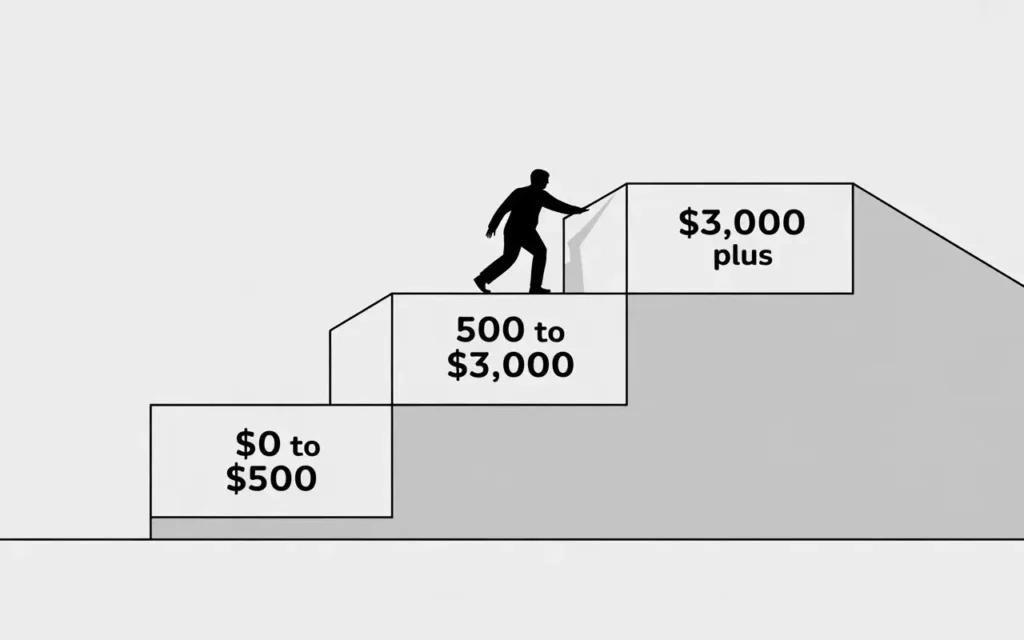
The truth is that blogging income falls into three fairly distinct stages, and most people starting out are nowhere near the ones that get written about.
Stage 1 ($0 to $500/month) is where every single blogger begins. This is the learning phase. You’re figuring out what content works, how to get traffic, and which monetization methods fit your niche. Most bloggers spend several months here, and that’s completely normal.
Stage 2 ($500 to $3,000/month) is where blogging starts to feel like a real side income. Reaching this stage means you’ve built consistent traffic, found at least one monetization method that converts, and stayed consistent long enough for things to compound.
Stage 3 ($3,000+/month) is where blogs become full-time income replacements. This stage requires all the right pieces working together — solid traffic, multiple income streams, strong SEO, and usually at least a year or two of consistent effort behind you.
What determines which stage you reach and how fast? We’ll get into that in a moment. But the most important thing to understand right now is that the published income reports you see online almost always represent Stage 3 bloggers, and they’re writing for an audience that’s still figuring out Stage 1.
That gap creates a lot of unnecessary discouragement. You’re not behind. You’re just at the beginning.
What Blogging Income Actually Depends On
People tend to think blogging income is mostly about writing talent or posting frequency. It’s neither. The factors that actually move the needle are more strategic than that.
Your niche determines your income ceiling before you write a single word. A blog about high-end software tools for businesses attracts an audience with serious purchasing power. A blog about free printable coloring pages does not. Both can earn money, but they’ll never earn the same amount per visitor. Niche selection isn’t just about what you enjoy writing — it’s about who you’re attracting and whether those people spend money in that space.
Traffic volume matters, but traffic quality matters more. Ten thousand readers who genuinely care about your topic and trust your recommendations will earn you more than one hundred thousand readers who landed on your page by accident and bounced in thirty seconds. Engaged readers click affiliate links. They buy products. They open your emails. Random visitors don’t.
One income stream is fragile. Multiple streams are a business. Bloggers who depend entirely on display ads are at the mercy of ad rates, which fluctuate constantly. Bloggers who combine ads, affiliate marketing, and a digital product of their own have far more stability. Building more than one income stream takes time, but it’s what separates a side hustle from a sustainable business.
Consistency over time is the actual engine of blogging income. Not brilliance. Not viral posts. Not a perfect strategy executed once. The bloggers earning serious money almost universally share one trait: they kept going when results were slow, and they kept improving while they waited.
Finally, and this one matters more than people admit: whether you treat your blog like a hobby or a business changes everything about how you approach it. Hobby bloggers post when they feel like it and measure success loosely. Business-minded bloggers set goals, track numbers, and make decisions based on data. Both approaches are valid — but only one of them reliably produces income.
A Realistic Month-by-Month Earning Timeline
Let’s put some honest expectations on the calendar, because most blogging guides either skip this entirely or frame it around someone else’s exceptional results.
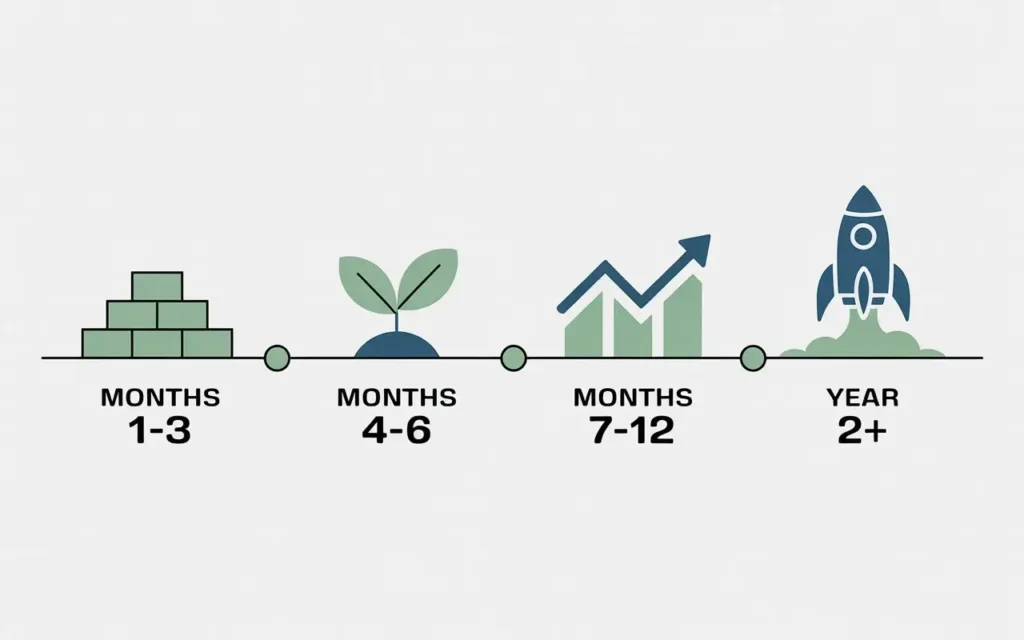
Months 1 to 3 are almost always a zero-income period, and that’s fine. You’re building content, learning your platform, figuring out your voice, and doing the foundational work that everything else will stand on. If you earn $10 or $50 during this phase, that’s a bonus — not an expectation. The readers who quit during this window almost always do so because they expected money faster than the internet was ever going to deliver it.
Months 4 to 6 are where you start seeing signals. If you’ve been consistent, you’ll notice your older posts starting to get picked up in search results. Traffic will grow slowly but noticeably. This is when applying for your first ad network starts making sense, and when early affiliate experiments can begin. Income at this stage might range from $50 to a few hundred dollars, depending on your niche and traffic volume.
Months 7 to 12 are where focused bloggers start to see real traction. Your content library is growing, your SEO is building momentum, and the income methods you tested earlier are starting to produce more reliably. Bloggers who reach this stage having stayed consistent often report their first months of $500 to $1,500+, with clear upward momentum.
Year 2 and beyond is where the compounding effect of content becomes undeniable. Posts you wrote in month 3 are now ranking on page one. Your affiliate links have a year of click history behind them. Your email list is working for you. This is when income can shift from promising to life-changing, but only for the people who made it through the slower first year.
Here’s the thing about slow starts: a slow start is not a signal that blogging isn’t working. It’s a signal that blogging is working exactly the way it always does. Content takes time to rank. Trust takes time to build. Income takes time to follow both of those things.
The bloggers who succeed are not the ones who started fastest. They’re the ones who didn’t quit when things were slow.
Choosing Your Blog Niche (The Decision That Determines Everything)

If you get your niche wrong, the best writing in the world won’t save you. If you get it right, even mediocre early content can grow into something real.
This is the most important decision you’ll make as a new blogger — and it deserves more than a bullet list of categories.
Why “Write What You Love” Is Incomplete Advice
You’ve probably heard the advice: write about something you’re passionate about. And honestly, there’s some truth to it. Passion helps you stay consistent when results are slow. It makes writing feel less like a chore. It comes through in the quality of your content.
But passion alone isn’t a business strategy.
There’s a common trap that catches a lot of new bloggers: you love a topic deeply, you build a beautiful blog around it, you write consistently for months — and then you discover that the audience for that topic doesn’t really spend money, or the ad rates are terrible, or there simply isn’t enough search volume to drive meaningful traffic.
That’s not a passion problem. That’s a research problem.
A viable blog niche needs to satisfy three things at once. You need to find it genuinely interesting enough to write about consistently. There needs to be real audience demand — meaning people are actively searching for information in that space. And there needs to be a clear path to monetization, whether through affiliate programs, products, advertising, or services.
Miss any one of those three, and you’re working uphill for a very long time.
Niche selection is a business decision. It can absolutely align with something you love — and ideally it does. But it has to make sense commercially, not just personally.
How to Evaluate a Niche Before Committing
The good news is you don’t need expensive tools to do this research. A few free methods will tell you almost everything you need to know.
Start with search volume. Type your potential niche topics into Google and look at the autocomplete suggestions. Those suggestions are based on real searches real people are doing. If Google is offering ten variations of your search term, people care about this topic. If it struggles to autocomplete at all, that’s a signal worth noticing.
You can also use Google Trends to see whether interest in your topic is growing, flat, or declining over time. A growing trend is a tailwind. A declining one is not where you want to build something long-term.
Check whether advertisers spend money in this space. Search a few core topics from your niche and look at the ads appearing in the results. Advertisers don’t pay for clicks unless there’s money to be made downstream. Lots of ads in a niche? That’s businesses competing for an audience that buys things. No ads at all? Worth asking why.
Look for affiliate programs. Search “[your niche] + affiliate program” and see what comes up. If established companies are running affiliate programs in your niche, that’s a strong signal that people buy products in this space and that you can earn commissions by recommending them.
Look at existing blogs in the niche. Are there other bloggers covering this topic who appear to be doing well? That’s not a reason to avoid the niche — competition means there’s an audience. What you want to see is that those bloggers are monetizing: running ads, promoting affiliate products, selling their own courses or ebooks. If existing blogs look active and monetized, you’ve confirmed that income is possible.
Understand the profitability ceiling. Some niches have very low ad rates regardless of traffic volume. Some niches have products to promote but low commission rates. Some niches have passionate audiences who simply don’t spend money online. These ceilings exist, and it’s worth researching them before you invest months of effort.
The Most Profitable Blog Niches Right Now (And Why)
Profitability in blogging comes down to one thing: does the audience in this niche have intent to spend money, and does the market support good monetization options?
With that in mind, these niches consistently produce strong blogging income:
Personal finance and money management ranks at the top for a reason. The audience is actively looking to improve their situation, financial products have high affiliate commissions, and ad rates in this space are among the best across all niches.
Health, fitness, and wellness attracts a massive audience with strong intent to invest in their health. Supplement affiliate programs, fitness courses, and equipment recommendations all convert well.
Career, business, and side hustles serves an audience motivated to spend on tools, courses, and resources that help them earn more. High purchase intent makes monetization straightforward.
Food and recipes generates enormous traffic volume, which makes it a display advertising goldmine even though individual purchase intent is lower. Volume compensates for lower per-reader value.
Relationships and self-improvement has a passionate audience and strong demand for books, courses, and coaching, all of which create solid affiliate and product income opportunities.
Parenting and family combines high emotional engagement with consistent consumer spending. Parents buy constantly, and parenting bloggers have no shortage of relevant products to recommend.
Tech, software, and productivity offers some of the highest affiliate commissions available, particularly for software products with recurring subscription models.
The pattern across all of these? Profitability is about audience intent to spend, not just topic popularity. A niche with a million curious readers beats a niche with ten million passive scrollers every time.
Narrowing Down: Why a Specific Niche Beats a Broad One
“Fitness” is a topic. “Strength training for women over 40” is a niche.
The difference matters enormously, especially when you’re starting from zero.
A broad niche means you’re competing with every major fitness publication, every established blogger, and every brand with a massive content budget. A specific niche means you’re serving a defined audience that nobody else is speaking to as directly as you are.
Narrow niches build authority faster. When every post on your blog serves the same specific reader with the same specific set of concerns, you become their go-to resource. That trust compounds quickly. Broad blogs spread authority thin across too many topics to dominate any of them.
Narrow niches attract loyal readers. Someone who feels like your blog was built specifically for them will come back. They’ll subscribe to your email list. They’ll buy what you recommend. Random visitors to a broad blog won’t do any of those things as reliably.
What about expanding later? Once you’ve established authority in your specific niche and built a real audience, expanding into adjacent topics makes sense. But doing it too early, before you’ve become the go-to resource for something specific, usually slows growth rather than accelerating it.
The Niche Validation Checklist
Before you commit to a niche, run it through these questions honestly:
Green flags — good signs your niche has income potential:
- People actively search for information in this niche (Google autocomplete confirms this)
- Advertisers are running paid ads for related searches
- Affiliate programs exist and offer reasonable commissions
- Other bloggers in the niche appear to be monetizing successfully
- The audience has demonstrated willingness to spend money in this space
- The topic has sustained or growing search interest over time
Red flags — warning signs worth taking seriously:
- Very few or no search results for core topics in your niche
- No affiliate programs exist or commissions are very low
- Existing blogs in the space appear inactive or unmonetized
- The topic is highly time-sensitive or trend-dependent with no evergreen angle
- The audience is largely seeking free information with no history of purchasing
No niche will check every box perfectly. But if you’re seeing more red flags than green ones, it’s worth refining your angle before you invest months of effort into something with a low income ceiling.
Setting Up Your Blog the Right Way (The Foundation That Makes Monetization Possible)
Most people think the technical setup is the boring part they have to get through before the real work starts.
It’s actually the decision you’ll be most glad you got right — or most frustrated you got wrong.
The Platform Decision: Why This Matters More Than People Realize
When you build a blog, you’re building on either land you own or land you’re renting.
Free blogging platforms like WordPress.com, Blogger, or Substack’s free tier give you a space to write — but they own the space, not you. They control the rules. They can change those rules. They can restrict how you monetize. They can limit which plugins or tools you use. And in worst-case scenarios, they can remove your content entirely.
That’s not a hypothetical. It happens.
Self-hosted WordPress (WordPress.org) is the industry standard for a reason. When you go self-hosted, you own your blog entirely. Your content lives on your own hosting account. You control every aspect of how it looks, how it functions, and how you make money from it. No platform can take it away or restrict what you do with it.
This is the option virtually every serious blogger uses, and it’s the one worth building on if income is your goal.
What about Squarespace or Wix? They’re genuinely good platforms for certain things — portfolios, small business websites, simple personal pages. But for a blog you intend to monetize seriously, both have limitations. Plugin availability is restricted. Customization ceilings exist. SEO flexibility isn’t as deep as WordPress. They’re not wrong choices for everyone, but they’re not the optimal choice for building a content-focused, monetized blog.
Hosting: What You Need and What You Don’t
Web hosting is simply the service that keeps your website accessible on the internet. Think of it as renting server space where your blog files live.
When you’re starting out, you don’t need the most expensive plan or the most powerful server. You need something reliable, fast enough to load pages quickly, and backed by support you can actually reach when something goes wrong.
What to look for in a beginner hosting plan:
- Consistent uptime (99.9% is the standard benchmark)
- Responsive customer support, ideally available around the clock
- Easy WordPress installation, usually one-click
- Pricing that makes sense for a beginner budget
What to avoid paying for early on:
- Dedicated server plans designed for high-traffic websites (you won’t need this for years, if ever)
- Unlimited everything packages that bundle features you won’t use
- Add-on services sold aggressively during signup that beginners rarely need
Realistically, solid beginner hosting costs somewhere between $3 and $10 per month depending on the provider and plan. Some providers offer promotional pricing for the first year that’s significantly lower. Your total first-year investment including hosting and your domain name should land somewhere between $50 and $120 for most beginners.
Domain Name: How to Choose One That Doesn’t Hurt You Later
Your domain name is your address on the internet. Getting it right matters more than most beginners realize, because changing it later is painful and can damage the SEO progress you’ve built.
What makes a good domain name:
- Easy to spell when someone hears it spoken out loud
- Short enough to remember without effort
- Relevant to your niche without being too restrictive as you grow
- Clean and professional-sounding
Common mistakes worth avoiding:
Many beginners try to be clever with their domain names. Unusual spellings, forced puns, or deliberately misspelled words all create friction. When someone hears your blog name mentioned and then tries to find it, they need to get there immediately.
Overly long domain names are also a problem. If your domain requires a hyphen to be readable, it’s probably too long. If you can’t say it in one breath, consider shortening it.
Keyword-stuffed domain names (something like “bestbudgettipsforsavingmoney.com”) read as spammy and feel dated. A cleaner brand name will serve you better long-term.
On the .com question: Yes, it still matters. Not because other extensions don’t work, but because .com is what people default to when they type a web address from memory. If your .com isn’t available, it’s worth rethinking the name rather than settling for a less familiar extension.
Before purchasing, do a quick trademark search to make sure the name isn’t legally protected, and check social media handles to see if they’re available. Consistency across your domain and your social profiles makes building a brand much cleaner.
Blog Design: What Actually Matters for a New Blog
Here’s an honest take on design that most people won’t give you: your blog’s design matters much less than you think in some ways, and more than you think in completely different ways.
A beautiful design won’t make up for weak content or a confusing layout. But a cluttered, slow-loading, unreadable design will absolutely drive readers away before they give your content a fair chance.
What a functional blog actually needs:
- Clear navigation so readers can find content easily
- Text that’s readable on both desktop and mobile screens
- Fast loading speed — every extra second of load time loses readers
- A clean layout that doesn’t compete with the content for attention
Free themes on WordPress can absolutely serve a new blogger well. Many of them are clean, fast, and flexible enough to grow with you. Spending money on a premium theme in month one, before you have any traffic or income to justify it, is not necessary.
The one design priority that matters most above everything else is trust. A blog that looks like a real person built it for a real purpose — with readable fonts, a sensible structure, and no visual chaos — earns the reader’s trust before they’ve read a single sentence. That trust is what keeps them on the page.
Design can be improved over time. Get it functional and clean at the start, and refine it as your blog grows.
Essential Plugins and Tools for Day One
WordPress plugins extend what your blog can do. The plugin library is enormous, and the temptation to install dozens of them immediately is real. Resist it.
Too many plugins slow your site down, create compatibility conflicts, and add complexity you don’t need yet. Start with the essentials only.
What you actually need from day one:
An SEO plugin (Rank Math and Yoast are the two most established options) helps you optimize each post for search engines. It doesn’t do the SEO work for you, but it gives you real-time feedback on things that matter, like whether you’ve used your target keyword in the right places and whether your content is readable.
Google Analytics tracks your traffic — how many people visit, where they come from, and which posts they read. Set this up before you publish your first post. You want clean data from the very beginning, not data with a gap at the start.
Google Search Console connects your blog directly to Google and tells you which search queries are bringing people to your site. It’s free, it’s essential, and most beginners ignore it for too long. Don’t make that mistake.
A basic security plugin sets up protection against common attacks and requires almost no ongoing attention once configured. It’s a one-time setup with long-term peace of mind.
What to leave alone for now: page builders, social media automation tools, membership plugins, e-commerce extensions, and anything else you don’t have a specific, immediate use for. Every plugin you add is a commitment. Keep that list short at the start.
Content Strategy — What to Write and Why It Determines Your Income
Most new bloggers think the hard part is setting up the blog. It isn’t. The hard part is figuring out what to write, why to write it, and how to make sure the right people actually find it.
Content is the engine of everything. Traffic comes from content. Income comes from traffic. Trust comes from consistently useful content over time. Get your content approach wrong and none of the other pieces matter. Get it right and almost everything else follows naturally.
The Difference Between Writing Content and Building a Content Strategy
There’s a very common pattern among new bloggers. They launch their site, feel genuinely excited, and then just start writing about whatever feels interesting that week. A personal story here, a list post there, a opinion piece whenever inspiration strikes.
Six months later they have thirty posts and almost no traffic. Not because the writing was bad, but because there was no plan behind it.
A content strategy simply means deciding in advance what you’ll write, who you’re writing it for, and what you want each piece of content to accomplish. That’s it. It doesn’t need to be complicated. But without it, you’re essentially publishing into a void and hoping something sticks.
The connection between strategy and income is direct. Content that’s planned around real search demand attracts consistent traffic. Consistent traffic creates monetization opportunities. Random content attracts random results, which usually means very little of either.
Understanding Search Intent: Writing What People Are Actually Looking For
Before you write a single post, you need to understand why people search for things online. Every search query falls into one of four categories, and knowing which one you’re targeting changes how you write entirely.
Informational intent is someone looking to learn something. “How does affiliate marketing work?” is informational. This is where most of your early content should live, because people searching for information are actively looking for exactly the kind of helpful, detailed content that blogs are built for.
Navigational intent is someone looking for a specific website or brand. “Mediavine login” is navigational. You can’t really compete for these searches as a new blogger, and you shouldn’t try.
Commercial intent is someone comparing options before making a decision. “Best email marketing tools for bloggers” is commercial. This type of content works well once you have some authority and traffic, and it converts beautifully for affiliate marketing.
Transactional intent is someone ready to buy. These searches are harder to rank for as a beginner, but highly valuable when you do.
Writing for informational intent first is the fastest path to traffic for a new blog. People searching for “how to” questions and explanations need exactly what a well-written blog post can provide. Match the intent of your target reader and Google rewards you for it. Mismatch it and even a perfectly written post goes nowhere.
Intent matching matters far more than keyword density. Stuffing a keyword into your post twelve times does nothing if the content doesn’t actually serve what the searcher was looking for.
To find what your readers are searching for without spending money, use Google’s autocomplete, the “People Also Ask” section in search results, and free tools like Google Trends or AnswerThePublic. These surfaces show you real queries from real people, which is exactly what you need.
The Three Types of Blog Posts Every Monetized Blog Needs
Not every post serves the same purpose, and treating them all the same is a common mistake.
Traffic-driving posts are designed to attract new readers from search engines and social platforms. These are typically informational posts targeting specific search queries. They cast the widest net and bring people into your world for the first time. Your blog needs plenty of these, especially in the early stages.
Authority-building posts go deep on a topic in a way that demonstrates genuine expertise. These are the posts other bloggers reference and link to, the posts that establish your credibility in your niche, and the posts that slowly build your reputation with both readers and search engines. You don’t need hundreds of these. A handful of genuinely outstanding, thorough pieces can do more for your authority than fifty average posts.
Conversion posts are designed to move readers toward a specific action, whether that’s joining your email list, clicking an affiliate link, or purchasing a product you’ve created. These posts tend to be more commercially oriented, like product reviews, comparisons, or recommendation lists.
A balanced content plan includes all three. A rough starting guide: roughly sixty percent of your posts should drive traffic, twenty percent should build authority, and twenty percent should focus on conversion. Adjust as you learn what your audience responds to.
How to Develop Blog Post Ideas That Have Real Demand
Writing a post nobody is searching for is like hosting an event nobody knows about. It might be excellent. Nobody will show up.
Before you write anything, validate the idea. Here’s how to do that without spending a cent.
Type your topic idea into Google and look at what autocompletes. Those suggestions reflect what real people are actually typing. Read through the “People Also Ask” boxes that appear in search results — each one is a real question your potential reader has asked. Browse Reddit communities and online forums in your niche and pay attention to the questions people ask repeatedly.
The gap method is particularly useful. Search your topic and read the top-ranking articles. Look for what they didn’t cover, what questions the comments section reveals readers still have, and what angles no one has taken yet. Writing a better, more complete version of something that already ranks is one of the most reliable content strategies available to new bloggers.
Free keyword tools like Ubersuggest (limited free searches) or Google’s own Keyword Planner can give you search volume estimates to help you prioritize. A topic with 2,000 monthly searches is almost always worth writing about. A topic with 20 might not be.
How Often Should You Post? The Honest Answer
The internet is full of advice telling new bloggers to post daily, or five times a week, or three times a week at minimum. Most of that advice is outdated and ignores how search engines actually evaluate content.
Consistency matters far more than frequency. One well-researched, genuinely useful post per week, published reliably every week, will outperform three rushed posts that don’t fully serve the reader.
Google doesn’t reward volume. It rewards quality and relevance. A blog with fifty exceptional posts will almost always outrank a blog with two hundred mediocre ones.
For most new bloggers, one to two posts per week is a realistic and effective cadence. It’s enough to build a content library steadily without burning out in month three.
When ideas feel scarce, go back to your research methods. Check what questions your existing readers are asking in comments. Revisit the “People Also Ask” sections for topics you’ve already covered. Look at what’s performing well and think about what adjacent topics your audience would naturally want to know.
Content Depth: Why Long-Form Content Tends to Win
Long-form doesn’t mean padded out. It means thorough.
Search engines consistently favor content that fully addresses what the reader came to find. A post that answers the question, anticipates the follow-up questions, and provides context tends to rank better than a post that skims the surface and leaves the reader searching for more.
Thoroughness is a trust signal. When a reader lands on your post and finds everything they were looking for in one place, they trust you. That trust is what brings them back, gets them on your email list, and eventually makes them someone who buys what you recommend.
The ideal length varies by niche and topic. A recipe post doesn’t need to be 3,000 words. A guide on how to start a blog probably does. The right length is whatever it takes to genuinely serve the reader, nothing more and nothing less.
Making long content readable is just as important as making it thorough. Short paragraphs, clear subheadings, and plain language turn a long post into something people actually read rather than scroll past.
How Bloggers Actually Make Money — Every Method Explained Honestly
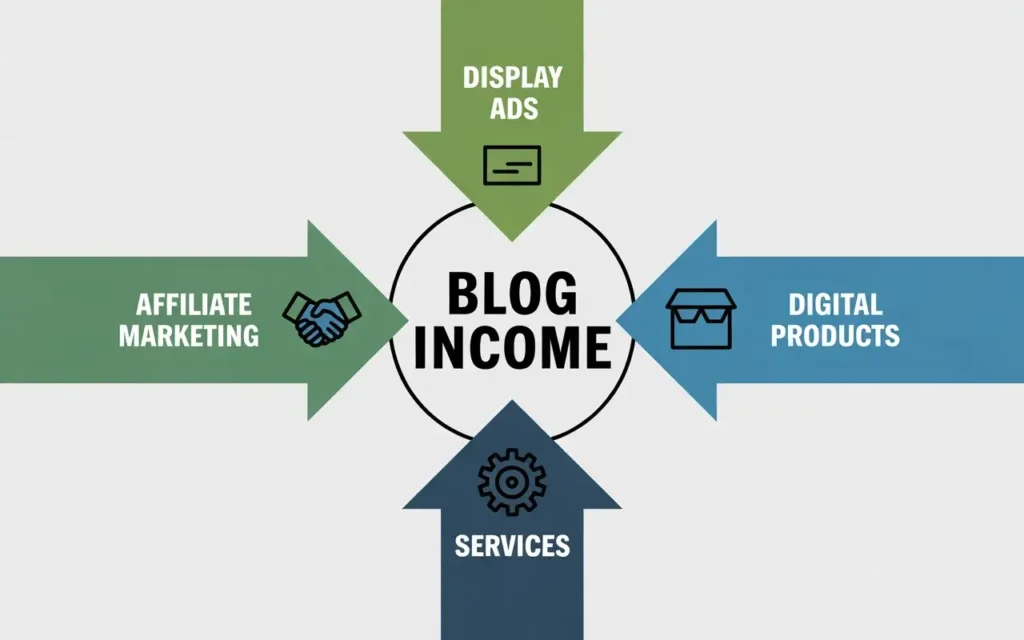
Here’s where most blogging guides get things wrong. They list the monetization methods, say something vague like “affiliate marketing is great for beginners,” and move on. You’re left without any real sense of which method to start with, how much you can actually earn, or what the honest tradeoffs are.
This section is going to be different. Every method, explained clearly, with honest expectations attached.
Display Advertising: The Passive Income Path (And Its Real Limitations)
Display advertising is the simplest monetization concept to understand. Advertisers pay to show ads on your blog, and you earn money based on how many people see or click those ads.
The appeal is obvious. Once ads are set up, they run in the background while you focus on creating content. No selling, no pitching, no customer service.
The honest limitation is that ads don’t pay meaningful money until you have real traffic volume. At 1,000 monthly page views, your ad earnings might cover a coffee or two. The math only becomes interesting at 25,000 to 50,000 page views per month and above.
Ad networks operate on a tiered system. Google AdSense accepts new blogs with minimal traffic, making it the typical starting point. The rates are low, but it’s accessible. As your traffic grows, premium networks like Mediavine (currently requiring 50,000 sessions per month) and AdThrive (100,000 monthly page views) become available. These networks pay significantly better, with RPMs (revenue per thousand page views) typically ranging from $15 to $50+ depending on your niche, compared to AdSense’s much lower rates.
Niche matters enormously for ad rates. Personal finance and insurance blogs earn some of the highest ad rates available. Food and lifestyle blogs earn moderate rates but compensate with high traffic volume. Entertainment and general interest niches tend to earn the lowest rates per visitor.
The biggest risk of depending heavily on ads is that you’re essentially renting your income from a third party. Ad rates fluctuate with the economy and seasonality. Network requirements change. Prioritize ads as one income stream, not your only one.
Affiliate Marketing: The Most Accessible Income Method for Beginners
Affiliate marketing is the closest thing to a beginner’s ideal monetization method, and it’s not even close.
Here’s the simple version of how it works: you recommend a product or service using a special tracking link. When someone clicks that link and makes a purchase, you earn a commission. The reader pays nothing extra. The company gets a customer they might not have found otherwise. You earn money for the recommendation.
You don’t need high traffic to start earning with affiliate marketing. A small audience that trusts you converts far better than a large audience that doesn’t. This is what makes it genuinely beginner-friendly in a way that display ads simply aren’t.
Finding affiliate programs beyond Amazon is easier than most people realize. Search “[your niche] + affiliate program” and you’ll find options. ShareASale, Commission Junction, and Impact are affiliate networks hosting programs across hundreds of niches. Software companies almost universally run affiliate programs, often with recurring commissions that pay every month the referred customer stays subscribed.
What makes affiliate content actually convert is honesty. Readers can smell a promotional post from a mile away. A genuine review that mentions both the strengths and the limitations of a product earns trust, and trust is what drives clicks and purchases. A post that reads like an advertisement earns nothing but skepticism.
Commission rates vary widely. Physical product affiliate programs (like Amazon) typically pay 1 to 10 percent. Digital products and software often pay 20 to 50 percent. Financial products sometimes pay flat fees of $50 to $200+ per referral.
The compound effect of affiliate content is one of its best features. A well-written review post you publish today can keep earning commissions two, three, and five years from now with no additional effort.
Selling Digital Products: The Highest Margin Income Path
Once you understand what your audience struggles with, you can create something that solves it and sell it directly. That’s the foundation of digital product income.
Digital products include ebooks, online courses, templates, printables, preset packs, and swipe files, among many others. The defining feature is that you create them once and sell them indefinitely with no inventory, no shipping costs, and minimal overhead.
The income-to-effort ratio of digital products is the best available to bloggers long-term. A $49 ebook that sells ten copies a month generates $490 in mostly passive income. A $197 course that sells five copies a month generates nearly $1,000. Both required significant upfront effort to create and essentially zero ongoing effort to sell.
Identifying what to create is simpler than most people make it. What does your audience ask about repeatedly? What problem comes up again and again in your comments or emails? The questions your readers ask most often are almost always the answers worth packaging into a product.
Timing matters. Creating a digital product before you have any audience to sell it to is a common and discouraging mistake. Wait until you have at least a modest readership, have established some trust, and have enough feedback to know what your audience genuinely needs.
Pricing as a new creator should be honest and fair, not artificially low. Underpricing your products signals low quality. A well-produced ebook is worth $27 to $49. A structured course with real depth is worth $97 to $297 or more.
Platforms like Gumroad, Payhip, and Podia make selling digital products straightforward without requiring any complex technical setup.
Sponsored Content: What It Actually Pays and When to Pursue It
Sponsored content means a brand pays you to write about them or feature their product on your blog.
The honest truth about sponsored content for beginners is that it’s worth understanding, but it’s rarely the right priority in your first year. Brands pay for access to engaged audiences, and building that audience takes time.
Once you have meaningful traffic (generally 10,000 to 25,000 monthly page views) and a clearly defined niche, reaching out to brands becomes realistic. You don’t need millions of readers to land sponsored deals. You need the right readers. A small, highly engaged audience in a specific niche is often more valuable to a relevant brand than a large, scattered general audience.
Pitching brands directly, rather than waiting for them to find you, is how most small bloggers get their first sponsored opportunities. A concise, professional pitch that explains who your audience is, what they care about, and why this brand is a natural fit will land better than a generic media kit.
Most new bloggers undercharge significantly for sponsored content. A reasonable starting rate is $100 to $300 per post for smaller blogs, scaling up substantially as your traffic and engagement grow. Research industry rates before you agree to anything.
The one real cost of sponsored content is reader trust. Every sponsored post you publish should genuinely serve your reader, not just the brand. If you start recommending things purely for payment rather than because they’re actually good, readers notice, and that trust is very hard to rebuild.
Services: The Fastest Path to Income for New Bloggers
This is the method almost nobody talks about in blogging income articles, and it’s the one that can put real money in your account fastest.
Your blog demonstrates expertise in your niche. That expertise has value beyond the blog itself. Freelance writing, consulting, coaching, social media management, and web design are all services you can offer based on the skills and knowledge your blog showcases.
Services earn faster than any passive method because there’s no traffic threshold to clear. You can land a freelance writing client in month one with zero page views, simply by showing them a handful of strong posts that demonstrate your writing ability and subject knowledge.
The typical path for bloggers who pursue services looks like this: services provide stable income in the early months while passive income methods are still building. As display ad revenue and affiliate income grow, the need to trade time for service income decreases. Eventually, many bloggers shift almost entirely to passive income, having used service income as a financial bridge during the building phase.
This sequencing makes blogging financially sustainable from a much earlier stage than most beginners realize is possible.
Email Marketing as a Monetization Engine (Not Just a Traffic Tool)
Most people think of email as a traffic tool. Send a newsletter, people click, they come back to your blog. That’s true, but it’s only half the picture.
An email list is the single most valuable asset a blogger can build, and it’s a monetization channel in its own right.
Email converts at dramatically higher rates than any other channel for affiliate marketing and digital product sales. Someone who has voluntarily signed up for your emails, read them regularly, and built a relationship with you over months is not the same as a cold visitor landing on your site for the first time. That relationship is worth money.
To grow a list from zero, you need something worth signing up for. A lead magnet, which is a free, useful resource you give away in exchange for an email address, is the most reliable approach. A checklist, a short guide, a template, or a resource list all work well. It should solve a specific problem your audience has and deliver immediate value.
Monetizing your email list ethically means treating your subscribers like real people rather than sales targets. Share genuinely useful content in most of your emails. When you recommend something, make it clear why you think it’s worth their time or money. Readers who trust your emails will buy what you recommend. Readers who feel sold to will unsubscribe.
Building Multiple Income Streams: The Stability Strategy
Every single monetization method listed above has a vulnerability. Ad rates drop. Affiliate programs change their commission structure. A sponsored deal falls through. A product launch underperforms.
Bloggers who depend on a single income stream find out about these vulnerabilities in the worst possible way.
Building multiple income streams isn’t about chasing every opportunity at once. It’s about sequencing them intelligently as your blog grows.
A sensible progression looks something like this: start with affiliate marketing in months one through six because it requires no traffic threshold and builds good content habits. Add display advertising once you hit a qualifying traffic level. Begin building toward a digital product once you understand your audience well enough to know what they’d pay for. Explore sponsored content once your traffic and engagement are strong enough to attract brands.
By the time you reach year two with this approach, you have four income sources working together. If one fluctuates, the others carry the weight. That’s not just a better income strategy. It’s a much calmer way to run a blogging business.
Getting Traffic to Your Blog — Without Paying for Ads
You can have the best content on the internet and earn exactly nothing from it if nobody ever finds it. Traffic is what turns writing into income, and building it without paying for ads is entirely possible. It just requires understanding which channels work, which ones are right for your niche, and how long each one takes to deliver results.
Why Traffic Strategy Should Start on Day One (Not Month Six)
Most new bloggers treat traffic as something to figure out after they’ve built up a content library. This is one of the most common and costly timing mistakes in blogging.
Organic traffic compounds over time. A piece of content you optimize for search on day one starts accumulating signals — clicks, time on page, backlinks, search impressions — from the very beginning. A piece of content you publish with no traffic strategy starts accumulating nothing.
Starting your traffic strategy on day one doesn’t mean you’ll see results on day one. It means that when results do start appearing, they’ll appear sooner and grow faster than if you’d started later.
The practical impact of traffic volume on income is also worth understanding clearly. At 5,000 monthly page views, your income options are limited mainly to affiliate marketing and early-stage ads. At 25,000 monthly page views, premium ad networks become accessible and affiliate income grows meaningfully. At 50,000 and above, you have the full range of monetization options available, and the income potential shifts dramatically.
Search Engine Optimization: The Long Game That Pays Forever
SEO traffic is the most valuable traffic a blogger can build. Not because it’s the fastest, but because it’s the most durable.
A social media post lives for hours or days. A well-ranking blog post lives for years. That’s the fundamental difference, and it’s why SEO should be part of your strategy from the very first post you publish.
Search engines rank content by evaluating three things. Content quality and relevance means how well your content actually serves the searcher’s intent. Technical health means whether your site loads quickly, works on mobile, and has clean structure that search engines can read. Authority means whether other credible websites link to yours, which signals that your content is trustworthy and worth recommending.
On-page SEO basics every new blogger can implement immediately:
- Use your target keyword naturally in your post title, first paragraph, and a few subheadings
- Write a clear, specific meta description that accurately describes what the post covers
- Use descriptive headings (H2 and H3) that reflect what each section covers
- Link to your own relevant posts within your content
- Make sure your images have descriptive alt text
How long does SEO take to produce results? Honestly, most new blogs see meaningful organic search traffic starting around month four to eight, depending on niche competition and content quality. It feels slow. It is slow. But the traffic you earn through SEO keeps coming without ongoing effort, which is what makes it worth the patience.
Pinterest: A Real Traffic Source for the Right Niches
Pinterest is not social media in the way Instagram or Twitter is. It functions as a visual search engine, and that distinction matters for how you use it and how to earn money from Pinterest.
People on Pinterest are actively searching for ideas, solutions, and inspiration. They’re not passively scrolling a feed. That search behavior makes Pinterest traffic more targeted and more likely to convert than most social traffic.
Pinterest works exceptionally well for specific niches: food and recipes, home decor and DIY, personal finance and budgeting, fashion and beauty, parenting, and health and wellness. If your niche has a visual component and a practically minded audience, Pinterest is worth your attention.
It works less well for highly technical topics, news-oriented content, B2B topics, and anything that doesn’t translate easily into a visual format.
Being consistent on Pinterest means publishing new pins regularly, using keyword-rich descriptions, and creating visually clear images that communicate what the content is about at a glance. Results take time to build, typically three to six months before you see meaningful traffic, but the traffic can become significant for the right niches.
What you can control on Pinterest: the quality and clarity of your pin images, the keywords in your descriptions and board titles, and your consistency. What you can’t control: algorithm changes, which happen regularly and can shift results unpredictably.
Social Media: Choosing the Right Platform for Your Blog
Spreading yourself across every social platform simultaneously is one of the fastest routes to burnout and mediocrity in blogging. Doing five platforms poorly helps nobody, least of all you.
Pick one platform and learn it well before considering anything else.
How do you choose? Match the platform to your content format and your audience.
Instagram and TikTok favor visual and short-form video content. They work well for lifestyle, food, fashion, fitness, and personal development niches. They require consistent content creation and tend to build audiences slowly for new accounts.
YouTube is powerful but demanding. A YouTube channel paired with a blog creates multiple discovery paths for the same audience, but video production requires significantly more time and equipment than written content.
Facebook still drives meaningful traffic for certain niches, particularly parenting, local community content, and older demographics. Facebook groups can be especially useful for building community around a specific topic.
Social media works best as a traffic amplifier, not your primary source. It can introduce new readers to your blog, but it’s unreliable as a standalone strategy because you don’t own your followers there and algorithm changes can eliminate your reach overnight.
Email as a Traffic and Retention Tool
Social media followers are borrowed. Email subscribers are yours.
When an algorithm changes, your social reach can drop to near zero with no warning. Your email list doesn’t work that way. Every person on that list voluntarily gave you their contact information, and you can reach them directly regardless of what any platform decides to do.
An email subscriber is worth ten to twenty times more than a social media follower in terms of traffic reliability and purchase likelihood. This is not an exaggeration. It’s a consistently observed reality across the blogging industry.
Growing a list from zero starts with having something worth signing up for. Offer a free resource that solves a specific problem your audience has. A checklist, a short guide, a resource list, a template — whatever genuinely helps your specific reader. Make it easy to find on your blog and mention it naturally within your content.
As your list grows, use it to drive traffic back to new posts. A simple email telling your subscribers about a new article you’ve published can send a meaningful spike of engaged traffic within hours of publishing, which also signals to search engines that your content is worth attention.
Collaborations, Guest Posts, and Community-Based Traffic
Writing for other blogs in your niche is an underused strategy that delivers two valuable things simultaneously: direct traffic from the host blog’s audience, and a backlink that strengthens your own site’s authority in search engines.
Guest posting doesn’t require you to have a large audience first. It requires you to have something genuinely useful to say to someone else’s audience. Pitch blog owners with a specific topic idea that would serve their readers, and make it clear you’re offering value, not just a link.
Backlinks remain one of the strongest signals in search engine ranking. A link from a credible, established blog in your niche tells search engines that your site is trustworthy. Earning these links through guest posts, original research, or content other bloggers naturally want to reference is the most sustainable approach.
Forum and community participation is an often overlooked traffic source. Answering questions genuinely and helpfully in Reddit communities, Facebook groups, or niche forums — without spamming your links — builds awareness and occasionally drives meaningful referral traffic. The key word is genuinely. People in communities can spot promotional intent immediately, and it backfires badly.
The Blogging Timeline — What to Actually Do in Each Phase
Understanding how blogging works is one thing. Knowing what to actually do this week, next month, and six months from now is something completely different.
This is the section most blogging guides skip entirely. They tell you what blogging income looks like and how monetization works, but they leave you staring at your screen wondering where to actually start. Consider this your phase-by-phase action map.
Phase 1 (Months 1 to 3): Building the Foundation
Your only job in the first three months is to build something worth growing.
That means getting your blog set up correctly, learning how your platform works, finding your voice, and publishing content consistently. Nothing else matters yet. Not ads. Not affiliate links. Not a social media presence on five different platforms.
Aim to publish between 15 and 25 posts before you start thinking seriously about monetization. This gives search engines enough content to understand what your blog is about, gives you enough material to learn from, and gives readers who do find you enough to explore. A blog with three posts and an affiliate link in every sentence tells readers you’re here to sell something. A blog with twenty genuinely helpful posts tells readers you’re here to help.
What not to do in this phase is just as important as what to do. Don’t apply for ad networks yet — you won’t qualify and the distraction isn’t worth it. Don’t try to build an audience on three social platforms simultaneously. Don’t obsess over your traffic numbers daily. Checking your analytics every few hours when you have 12 visitors a day is the blogging equivalent of watching paint dry.
Track these things instead: how many posts you’ve published, whether your writing is getting clearer and more confident over time, and whether you’re learning something new about your niche and your reader with every piece you write. These are the leading indicators that matter in phase one.
The mindset you need here is simple but hard to maintain: you’re planting seeds, not harvesting a crop. Nothing visible is happening above ground yet. That doesn’t mean nothing is happening.
Phase 2 (Months 4 to 6): Building Momentum
This is where the first real signals start appearing, and where a lot of bloggers make the mistake of either giving up too soon or celebrating too early.
Signs that your content strategy is working: older posts start climbing in search results, your monthly page views show a consistent upward trend even if the numbers are still modest, and readers start leaving comments or sharing posts. These are signals worth paying attention to. They tell you the foundation is holding.
This is the right time to set up your first affiliate marketing. You have enough content for readers to trust you, and affiliate links placed in genuinely helpful posts will start earning small commissions without feeling out of place. Start with products you’d actually recommend to a friend, not whatever pays the highest commission.
If you’re approaching 10,000 monthly page views, it’s worth looking at entry-level ad networks. You won’t earn much yet, but setting it up now means you’re earning something while you continue building.
The most common reason blogs stall at this phase is a traffic strategy problem. Bloggers who published content without thinking about search intent in phase one often reach month five and wonder why nobody is finding them. If that’s you, don’t panic. Go back to your existing posts and optimize them for the search terms your target reader is actually using. It’s worth the effort.
Analyze what’s already working. Which posts are getting the most traffic? Which ones have the highest time-on-page? Write more content in those directions. Your audience is telling you what they want. Listen to them.
Phase 3 (Months 7 to 12): Starting to Earn Consistently
By month seven, focused bloggers typically start seeing something that feels like momentum. Traffic is growing month over month, early affiliate commissions are appearing regularly, and the blog is starting to feel like a real thing rather than an experiment.
If you haven’t started building an email list yet, start now. Don’t wait any longer. Create a simple lead magnet relevant to your niche and add a signup form to your most-visited posts. Every month you delay building your list is a month of potential subscribers you can’t get back.
This phase is also when content analysis becomes genuinely valuable. Look at your top ten performing posts and ask honestly: what do they have in common? Are they a specific format? Do they target a particular type of keyword? Do they solve a specific type of problem? Whatever pattern you find, create more content in that direction intentionally.
The income plateau is a real phenomenon in this phase and it catches a lot of bloggers off guard. You reach a certain monthly income level and then it seems to stop growing. The fix is almost always diversification. If you’ve only been using one monetization method, add another. If you’ve only been using one traffic source, start building a second. Plateaus rarely mean you’ve hit a ceiling. They usually mean you’ve exhausted one approach and need to layer in another.
This is also a reasonable time to start thinking about your first digital product, not building it yet, but identifying what your audience consistently asks for and whether there’s a product opportunity worth developing.
Phase 4 (Year 2 and Beyond): Scaling and Stabilizing
Year two is where blogging starts feeling like an actual business rather than an optimistic side project.
The content you published in months one through twelve is now aging into authority. Posts that struggled to rank in their first few months have accumulated enough signals to climb the search results. This is the compounding effect people talk about, and it genuinely is as powerful as they describe. Traffic grows without requiring proportional increases in effort.
This is the right phase to diversify your traffic sources if you haven’t already. If Pinterest has been your primary traffic driver, start investing in SEO. If SEO has been carrying everything, explore whether Pinterest or YouTube makes sense for your niche. Relying on a single traffic source in year two is an unnecessary risk.
Reinvesting in your blog also starts making financial and strategic sense at this stage. A premium theme, a professional email marketing platform, a keyword research tool with full features, or even hiring someone to help with specific tasks can all accelerate growth meaningfully when you have the income to support them.
What separates bloggers who plateau in year two from bloggers who scale? The ones who scale treat their blog like a business with a strategy, not a content machine they feed indefinitely. They look at their data, make decisions based on what it tells them, and continuously refine rather than just publish more.
The mindset shift that unlocks this phase: you’re not just a blogger anymore. You’re running a content business. That shift in how you think about decisions, investments, and priorities changes everything about how you operate.
The Mistakes That Quietly Kill Most Blogging Businesses

Every blogger makes mistakes. The ones who succeed are simply the ones who catch them early enough to recover. Here are the ten that take down the most promising blogs before they ever get traction.
Choosing a Niche Based on Passion Alone
Passion keeps you writing. But passion alone doesn’t pay you.
The bloggers who build a beautiful site around something they love, only to discover six months in that nobody is searching for it or that the audience has no history of spending money in that space — these stories are far more common than the income reports suggest.
The simple check that saves months of wasted effort: before committing to a niche, verify that people are actively searching for information in that space, that affiliate programs or ad revenue opportunities exist, and that other bloggers in the niche show signs of actually earning money. Passion plus market validation is a business. Passion alone is a very satisfying hobby.
Starting on a Free Platform With Plans to “Move Later”
“I’ll start free and switch to self-hosted once I’m making money” sounds reasonable. It isn’t.
Moving a blog after you’ve built content, gained backlinks, and established any search presence is technically complex, frequently messy, and almost always costs you traffic during the transition. The SEO equity you’ve built doesn’t transfer cleanly. Some of it simply disappears.
Self-hosting costs less than $10 a month. Starting there from day one is the obvious choice when you compare that cost to the headache of migrating later.
Writing Content Nobody Is Searching For
There’s a meaningful difference between writing what you find interesting and writing what your reader is actively looking for.
A post you write because it felt like a good idea this week might earn zero organic traffic for its entire lifetime. A post you write because 3,000 people search for that exact question every month will earn traffic on autopilot.
Validating a post idea takes five minutes. Type it into Google, check the autocomplete suggestions, read the “People Also Ask” boxes, and look at what’s already ranking. If the demand is there, write the post. If it isn’t, move to the next idea.
Monetizing Before Building Trust
Covering your first ten posts in affiliate links before you have a single loyal reader is like trying to sell something to a stranger who just walked in off the street. It doesn’t work, and it makes a bad first impression.
Trust comes before conversion, always. Readers need to believe that you genuinely know what you’re talking about and that your recommendations come from real experience before they’ll click a link or buy what you suggest. Build that trust with consistent, genuinely helpful content first. The monetization becomes far more effective once the relationship is real.
Spreading Across Too Many Traffic Channels at Once
Trying to be active on Pinterest, Instagram, TikTok, Twitter, and YouTube simultaneously while also writing blog posts and responding to comments is not a growth strategy. It’s a recipe for burnout and mediocrity across the board.
Every platform you add divides your attention. And divided attention produces weak results everywhere rather than strong results anywhere. Pick one external traffic channel, learn it properly, and build real traction there before you consider anything else.
Quitting During the Trough
The trough is real and predictable. It hits somewhere between month two and month five for most bloggers. The initial excitement of launching has worn off. Results are slow or nonexistent. The work feels thankless.
This is exactly where most blogs die.
What the data consistently shows is that bloggers who stick with a quality-focused, consistent strategy for twelve months almost always see meaningful results by the end of that period. The ones who quit in month four never find out what month eight would have looked like.
The question worth asking when you’re in the trough isn’t “is this working?” It’s “have I given this enough time and consistent effort to fairly judge?” Those are very different questions with very different answers.
Ignoring SEO Until It’s Painful to Fix
Going back to retrofit SEO into fifty posts you already published is genuinely painful work. Rebuilding internal linking structures, rewriting titles, updating meta descriptions, and restructuring content that ranked for nothing because it wasn’t optimized — all of this takes time that proper early habits would have prevented.
Learning basic on-page SEO before you publish post one costs you an afternoon. Fixing the absence of it across a year’s worth of content costs you weeks. Do it upfront.
Comparing Your Month 3 to Someone Else’s Year 3
Income reports are almost always written by people who’ve been at this for years, describing their results as if they’re the natural outcome of following a simple process. They rarely mention that they had three failed blogs before this one, that they learned from expensive mistakes you’re about to avoid, or that their month three looked exactly as slow as yours does.
The only fair comparison you can make is between where you are now and where you were three months ago. That comparison shows real progress. The other comparison just manufactures discouragement.
Never Building an Email List
Algorithm changes are not hypothetical. They happen regularly, and when they do, bloggers who built their entire traffic model on a single platform can watch their monthly visitors drop by 60 percent overnight with no recourse.
Bloggers with email lists don’t have that problem. Their list is theirs. No algorithm controls it. No platform can take it away. Every person on that list came to them voluntarily and can be reached directly regardless of what any social platform or search engine decides to do next.
Build your email list from day one, even if it grows slowly. Your future self will be genuinely grateful.
Treating Blogging as a Hobby When You Want Business Results
This one is subtler than the others, but it matters enormously.
Hobby bloggers post when inspiration strikes, avoid looking at data because it feels unromantic, and measure success by how proud they feel of their content. None of that produces income reliably.
Business-minded bloggers set monthly content goals and keep them. They check their analytics and make decisions based on what the numbers say. They treat their blog time as protected work time, not optional leisure. They reinvest earnings back into growth rather than treating every dollar as profit to spend immediately.
The blog itself doesn’t change. The mindset behind it does. And that mindset difference is often what separates the bloggers who wonder why nothing is working from the ones who understand exactly what to do next.
The Mental Side of Blogging — What Nobody Prepares You For

Every practical guide tells you what to do. Almost none of them tell you how it’s actually going to feel.
Blogging is a long, slow build in a world that’s conditioned you to expect fast results. Understanding the emotional reality of that journey before you start is one of the most valuable things you can do for your long-term success.
The Emotional Stages of Early Blogging (And Why They’re Normal)
The pattern is remarkably consistent across bloggers who eventually succeed. It goes something like this.
You start with genuine excitement. The blog feels new and full of possibility. Writing comes easily because motivation is high. You publish your first few posts and feel genuinely proud of them.
Then you hit the silence period. You’re publishing consistently but traffic is nearly nonexistent. Comments aren’t coming. Income is zero. The excitement from week one is a distant memory. This is where the doubt sets in.
The silence period is not a signal that blogging isn’t working for you. It’s a normal, predictable phase that virtually every successful blogger passed through. The ones who make it are not the ones who escaped the silence period. They’re the ones who kept publishing through it.
Knowing this pattern exists before you hit it changes everything. When the doubt arrives, you recognize it for what it is — a predictable stage — rather than a verdict on your potential. That recognition is often the difference between continuing and quitting.
The Comparison Trap and How It Destroys Progress
Reading income reports when you’re in month two of your blog is genuinely dangerous for your motivation.
Not because the income reports are fake, but because your brain doesn’t process them as “this person’s year three result.” It processes them as “this is what blogging produces, and I’m producing nothing, so something must be wrong with me.”
Nothing is wrong with you. Your timeline is simply different from theirs. That person’s month two probably looked exactly like yours does.
The only comparison worth making is against your own previous self. Are you a better writer than you were in month one? Is your understanding of your niche and your reader deeper than it was? Are you making smarter content decisions than you were ninety days ago? That’s progress. It’s real even when the traffic numbers don’t show it yet.
Managing Motivation During Zero-Result Periods
Motivation based on results is unreliable when results are slow to appear. And in blogging, results are almost always slow to appear at the beginning.
Motivation based on systems is far more durable. Instead of waiting to feel motivated, you build a routine. You write on specific days at specific times. You treat those sessions like appointments that don’t get canceled. You complete the action whether or not you feel inspired that day.
This is not about grinding yourself into exhaustion. It’s about decoupling your consistency from your emotional state, because your emotional state in month two of a slow build is not a reliable guide.
When traffic and income aren’t there yet, track leading indicators instead. How many posts have you published? Is your keyword research improving? Are your titles getting clearer and more targeted? Are your posts getting longer and more thorough? These are the inputs that eventually produce the outputs. Tracking them keeps you focused on what you can actually control.
Avoiding Burnout While Building From Nothing
There’s a particular trap that catches motivated new bloggers: they treat the early months like a sprint when blogging is fundamentally a marathon.
Publishing seven posts in week one, redesigning the site twice, learning Pinterest strategy, setting up email marketing, and researching monetization methods simultaneously is not hustle. It’s the setup for burnout in month three.
More hours does not equal more results in blogging. A well-researched, genuinely useful post published once a week beats three rushed posts published daily, both for reader trust and for search engine performance.
Build a schedule you can sustain for two years, not one you can barely maintain for two weeks. Blog around your life rather than replacing it. Protect your energy because you’re going to need it for the long haul, and the long haul is exactly what blogging requires.
Tools That Actually Help (And What You Don’t Need Yet)
The blogging tools industry has a vested interest in making you think you need dozens of products before you can get started. You don’t. Most of what gets sold to new bloggers is either premature, unnecessary, or something you can get free elsewhere.
Here’s an honest breakdown of what actually matters, when it matters, and what you can safely ignore.
The Only Tools You Need in Month One
Keep this list short. Seriously.
Hosting and a domain name are non-negotiable. Everything else lives on top of these two things. Without them you don’t have a blog. With them, you have everything you need to get started.
A free WordPress theme that loads quickly and looks clean is completely sufficient for month one. You don’t need a premium theme yet. You need something readable, mobile-friendly, and fast. Dozens of free options inside WordPress satisfy all three criteria without spending a cent.
An SEO plugin like Rank Math or Yoast gives you real-time feedback as you write each post, flagging things like whether you’ve used your target keyword in the right places and whether your content is readable. Both have solid free versions. Install one, learn how it works, and use it from your very first post.
Google Analytics and Google Search Console are free, essential, and something every blogger should set up before publishing anything. Analytics shows you who’s visiting and what they’re reading. Search Console shows you what searches are bringing people to your site. Together they give you the data you need to make smart decisions. Setting them up on day one means you’ll have clean historical data from the very beginning.
A free email capture tool deserves a spot on this list even in month one. You might only collect five email subscribers in your first month. That’s fine. The habit of building your list from the start is what matters, and free tools like Mailchimp’s free tier or MailerLite’s free plan handle this perfectly until your list grows large enough to warrant upgrading.
Tools Worth Adding When You Start Earning
Once your blog is generating income, reinvesting some of it into better tools makes real sense. Here’s what’s worth prioritizing.
A premium theme or page builder becomes relevant when your current design is actively limiting you. If readers are struggling to find content, if your layout looks dated, or if you want more customization than your free theme allows, this is a reasonable upgrade. Not before.
A scheduling tool for Pinterest or social content saves meaningful time once you have enough content to promote consistently. Tools like Tailwind for Pinterest help you stay active on the platform without spending hours on it manually each week.
A professional email marketing platform with full automation features becomes worth paying for once your list grows past a few hundred subscribers and you want to send automated sequences, tag subscribers by interest, or run more sophisticated campaigns.
A keyword research tool with paid features like Ahrefs or Semrush gives you deeper data on search volume, competition, and content gaps. These tools are genuinely powerful but genuinely expensive. They’re worth it once your blog is earning enough to justify the investment, not before.
Tools That Are Oversold to Beginners
Some tools get marketed heavily to new bloggers and deliver far less value than their price tags suggest.
Grammar and writing tools like Grammarly’s premium version are useful for catching errors, but they’re not a substitute for developing your own writing voice. The free version catches most of what matters. Spending $30 a month on premium grammar software in month one of a blog that earns nothing yet is a misplaced priority.
Expensive course bundles with unfocused content appear everywhere in the blogging space. A $300 bundle covering seventeen different topics sounds like a bargain until you realize you only needed two of those topics and the rest was padding. Focused, specific resources beat broad bundles almost every time.
Social media management tools before you have a social media strategy are just expensive ways to schedule content nobody sees yet. Build the strategy first. Add the tool when it solves an actual problem.
Stock photo subscriptions are unnecessary when free options like Unsplash and Pexels offer high-quality images at no cost. Paying monthly for stock photos in year one, when free alternatives are fully adequate, is money that could go toward something that actually moves the needle.
The $0 Blogging Stack: What You Can Legitimately Use for Free
You can run a serious blogging operation in your first year using almost entirely free tools. Here’s what a complete free stack looks like:
- WordPress.org for your platform (free, installed through your hosting)
- A free WordPress theme for design
- Rank Math or Yoast free version for SEO
- Google Analytics for traffic data
- Google Search Console for search performance data
- MailerLite or Mailchimp free tier for email list building
- Canva free version for creating images and Pinterest graphics
- Ubersuggest free searches for basic keyword research
- Google Trends for topic validation
- Unsplash and Pexels for free photography
The free versions of these tools become limiting at very specific points. You’ll know when you’ve hit those limits because you’ll find yourself wanting to do something the free version won’t let you do. That’s the right time to upgrade, not before.
The Business Side of Blogging (What Most Beginner Guides Skip Entirely)
Nobody talks about this part. Most blogging income guides take you from “start a blog” to “make money” without ever mentioning that the moment you earn your first dollar, you’ve become a business owner with actual financial responsibilities.
This section won’t replace professional advice. But it will make sure you’re not caught completely off guard.
When Your Blog Income Becomes Taxable (And Why This Matters Earlier Than You Think)
Here’s the uncomfortable truth most blogging guides avoid: blog income is taxable income, and in most countries it becomes reportable from the very first dollar you earn, not from some threshold that feels more significant.
The exact rules vary by country, and you should absolutely consult a local tax professional rather than relying on blog advice for something this important. But the general principle holds almost universally: if your blog is earning money, the tax authority in your country considers that income.
The problem isn’t that people don’t know this. The problem is that they know it abstractly and then spend the first year treating every affiliate commission and ad payment as purely extra spending money. Then tax season arrives and the math is suddenly uncomfortable.
The simple habit that prevents this problem: from the very first payment your blog earns, move a percentage of it into a separate account designated for taxes. Twenty to thirty percent is a reasonable starting point in many tax systems, though your actual rate depends on your total income and your country’s rules. Ask a professional. Set the habit early.
Tracking Income and Expenses as a Blogger
Tracking your blogging income and expenses serves two purposes. It shows you your actual profit, not just your revenue, and it reduces your tax burden by documenting the legitimate business expenses you can deduct.
What to track on the income side: every payment from every source, including ad networks, affiliate programs, digital product sales, and sponsored content. Keep records of when payments arrived and which platform they came from.
What to track on the expense side: hosting costs, domain renewal, any tools or subscriptions you pay for, courses or resources you purchase for your blog, and any equipment you buy specifically for blogging purposes.
You don’t need accounting software to do this in year one. A simple spreadsheet with columns for date, description, income, and expense works perfectly well. The habit of recording things as they happen is what matters. Trying to reconstruct a year’s worth of transactions in December is nobody’s idea of a good time.
When to Formalize Your Blog as a Business
“Formalizing” means registering your blog as a legal business entity, typically a sole proprietorship, LLC, or equivalent structure depending on where you live.
In practical terms, most bloggers don’t need to formalize immediately. But as income grows, formalization offers real benefits: cleaner separation between personal and business finances, potential liability protection depending on your structure, and sometimes tax advantages worth exploring with a professional.
The general point at which formalization starts making sense is when your blog is generating consistent monthly income. A few hundred dollars a month probably doesn’t require an LLC. Several thousand dollars a month probably warrants a conversation with an accountant or business attorney.
This is genuinely an area where professional advice is worth paying for. The rules are jurisdiction-specific, the implications are real, and getting it right costs far less than getting it wrong.
Reinvesting in Your Blog: When and How
Every dollar you reinvest in your blog intelligently has the potential to earn you several dollars back. That’s not hype. It’s the basic logic of treating a blog like a business rather than a side hustle you extract money from immediately.
The reinvestment principle is simple: as your blog generates income, allocate a portion of it back into things that accelerate growth. What those things are depends on your specific situation, but a reasonable progression looks like this.
Upgrade your email marketing platform when your list outgrows the free tier. Invest in a focused course or resource that addresses a specific gap in your knowledge. Upgrade your theme when your design is genuinely limiting your reader experience. Consider outsourcing specific tasks, like graphic design or editing, when your time is better spent on content creation.
The compounding effect of strategic reinvestment is real. Better tools produce better content. Better content attracts more traffic. More traffic generates more income to reinvest. The bloggers who scale fastest are almost always the ones who treat earnings as fuel for growth rather than immediate profit.
Frequently Asked Questions — Real Questions Real Beginners Ask
How long does it realistically take to make money blogging?
Most bloggers who stay consistent see their first small earnings somewhere between months three and six. Actual meaningful income, meaning enough to feel significant, typically appears between months six and twelve for bloggers who focus on content quality and a deliberate traffic strategy.
The honest answer involves two variables: how consistently you publish quality content and how strategically you approach traffic and monetization. Bloggers who treat it as a business from day one tend to see results faster than those who treat it casually. Year two is where income tends to compound noticeably for bloggers who made it through the slow first year.
How much money can a beginner blogger realistically make in year one?
The range is genuinely wide. A blogger who publishes sporadically with no traffic strategy might earn close to nothing. A blogger who publishes consistently, focuses on SEO and one social platform, and implements affiliate marketing thoughtfully might earn $500 to $2,000 over the course of their first year.
The variables that matter most: niche profitability, content quality, traffic volume, and which monetization methods you use. Year one income for most focused bloggers falls somewhere between a few hundred and a few thousand dollars total. Year two, if you stick with it, tends to look significantly better.
Do you need to be a good writer to make money blogging?
No. But you need to be a clear writer. Those aren’t the same thing.
Blogging doesn’t reward literary talent. It rewards clarity, usefulness, and the ability to explain things in a way that makes the reader feel helped. If you can write in plain language, organize your thoughts logically, and focus on serving the reader rather than impressing them, you have everything you need. Your writing will also improve naturally the more you publish.
Is blogging still worth starting in 2025?
Yes, with realistic expectations attached.
The blogging landscape is more competitive than it was ten years ago, and getting traffic from Google takes longer for new sites than it once did. Those are honest realities. But the fundamentals haven’t changed: people search for information constantly, helpful content still ranks, and niche audiences still convert well for the right monetization methods.
The bloggers who struggle are the ones expecting 2010-era results on a 2025 timeline. The bloggers who succeed are the ones who understand that quality, consistency, and patience still work, they just take longer to pay off than the income reports suggest.
What happens if you pick the wrong niche?
You have three realistic options, and which one applies depends on how far along you are.
If you’re in the first three months, switching niches costs you relatively little. Start fresh with better research. If you’re six months in with real content published, consider narrowing your niche rather than abandoning it entirely. A blog about general wellness might pivot to focus specifically on wellness for shift workers, for example. If you’re a year in with genuine traffic but low monetization, the problem might not be the niche itself but the monetization strategy. Audit both before you decide.
The sunk cost of published content shouldn’t trap you in a niche with no income potential. But don’t assume the niche is wrong before you’ve thoroughly examined whether the strategy is the actual problem.
Can you make money blogging without social media?
Yes. SEO-focused blogs earn real income without any social media presence at all.
The tradeoff is time. Social media can accelerate early traffic before your SEO gains traction. Without it, you rely entirely on search traffic, which takes longer to build. If you’re willing to be patient and consistent with your SEO strategy, social media is optional. If you want faster early traction, choosing one platform and using it well helps bridge the gap.
How many blog posts do you need before you make money?
Post count is the wrong metric. Quality and search demand are what actually matter.
That said, having somewhere between 15 and 25 solid posts gives you enough content for search engines to understand your niche and enough for readers who do find you to explore. You could technically earn affiliate income from your very first post if it targets the right keyword and someone reads it and clicks your link. But consistent income requires a content library large enough to drive consistent traffic.
Do you need to show your face or use your real name to blog?
No. Anonymous and pseudonymous blogs earn real income all the time.
What anonymity costs you is some degree of personal connection with your audience, and potentially some trust in niches where personal credibility matters, like health or finance. It also makes certain monetization methods harder, like coaching or personal brand partnerships.
If privacy is important to you, build your brand around a pen name or a blog brand name rather than your personal identity. Thousands of successful blogs operate this way. Just be consistent with whatever identity you choose.
What is the fastest way to make your first $100 blogging?
Affiliate marketing targeting a specific, commercially-minded search query is the most reliable fast path.
Here’s the practical version: identify a product in your niche that has an affiliate program. Write a genuinely useful, honest review or comparison post targeting the exact search term someone would use when they’re already thinking about buying or trying that product. Optimize it for search. Share it on whichever platform your audience uses. When someone reads it and clicks through to make a purchase, you earn a commission.
This approach can produce your first $100 within weeks for bloggers who execute it well. It requires the right niche, a commercially-focused post, and some traffic. It’s not guaranteed, but it’s the most direct path available.
Can you make money blogging about anything?
Not equally. Some topics monetize beautifully. Others have passionate audiences who almost never spend money online.
The topics that monetize well share common characteristics: the audience has a problem they actively want to solve, products or services exist that help solve it, and those products have affiliate programs or the audience responds to advertising. Personal finance, health and fitness, software and productivity, career development, and parenting all tend to monetize well for these reasons.
Before committing to a topic, check whether affiliate programs exist in that space, whether advertisers run paid ads for related searches, and whether existing blogs in the niche show signs of earning income. If all three are true, your topic has income potential. If none are true, reconsider before you invest months of effort.
You Have More Than Enough to Start
Making money blogging is real. It’s not a shortcut, not a passive income fantasy you set up over a weekend, and not something that works for a special category of people you don’t belong to. It’s a legitimate income path built on content that serves real readers, traffic built over time through smart strategy, and monetization that earns trust before it earns commissions.
The gap between bloggers who earn and bloggers who don’t almost never comes down to talent, writing ability, or even niche selection. It comes down to two things: whether they stayed consistent long enough for compounding to work, and whether they treated their blog like a real business rather than a hopeful experiment.
You now know the honest income timeline. You know how to evaluate a niche before you commit to it. You know how to set up your blog correctly from day one, build a content strategy around real demand, drive traffic without paying for ads, and layer in multiple income streams as your blog grows.
Your one action for today is simple: decide on your niche. Not perfectly. Not with complete certainty. Just well enough to start. Run it through the validation checklist from section two, confirm that the market supports it, and commit to it long enough to give it a genuine shot.
The bloggers who look back at their first year with pride didn’t start with more knowledge than you have right now. They just started.