The Honest Guide to Making Money With Affiliate Marketing (No Hype, No Shortcuts, No Fluff)
Before You Start — What Nobody Tells You About Affiliate Marketing
You’ve seen the screenshots. The income reports. The thumbnails with someone pointing at a number that has way too many digits in it. “I made $47,000 last month with affiliate marketing — here’s how!”
And somewhere in the back of your mind, a quiet voice says: is any of this actually real?
That instinct is healthy. You should be skeptical. Because while affiliate marketing is genuinely one of the most legitimate ways to earn money online, the way it gets talked about on the internet is mostly misleading. Not because it doesn’t work. It does. But because the people shouting the loudest about it have a reason to make it sound easier and faster than it actually is.
Here’s what most of those flashy posts won’t tell you: affiliate marketing takes real time, real effort, and a real strategy. It’s not a tap you turn on. It’s not passive from day one. And it’s definitely not something that works just because you slap a few links on a page and wait.
That’s the honest starting point. And if you’re still reading, I think you already knew that.
This article exists because you deserve a straight answer. Not a sales pitch dressed up as advice. You’ll find out exactly how affiliate marketing works, what it actually takes to earn from it, which mistakes silently kill most beginners before they ever see a dollar, and how to build something that grows over time. No course to sell you. No dream to protect.
Just everything you actually need to know, laid out as clearly as possible.
Whether you’re starting from absolute zero or you’ve tried this before and felt stuck, you’re in the right place.
What Affiliate Marketing Really Is — Explained Simply, Without the Buzzwords
The Simplest Way to Understand It
Think about the last time a friend recommended something to you. Maybe it was a mechanic who never overcharged, a dentist who didn’t make you feel guilty for skipping flossing, or a phone repair shop that actually fixed the problem the first time.
You probably didn’t need much convincing. You trusted your friend. You went. The mechanic got a new customer.
Your friend got nothing.
Affiliate marketing is basically that same situation, except this time you actually get paid for the recommendation. That’s genuinely the whole idea. When someone buys something because you pointed them toward it, you earn a cut of that sale. No product to create. No inventory to store. No customer service to handle. You simply connect the right person to the right thing, and the merchant rewards you for it.
It sounds almost too simple, which is probably why so many people assume there must be a catch. There isn’t a catch. There’s just a process, and understanding that process is what separates people who actually earn from affiliate marketing from the people who try it for a few weeks and give up.
The Three People Always Involved in Affiliate Marketing
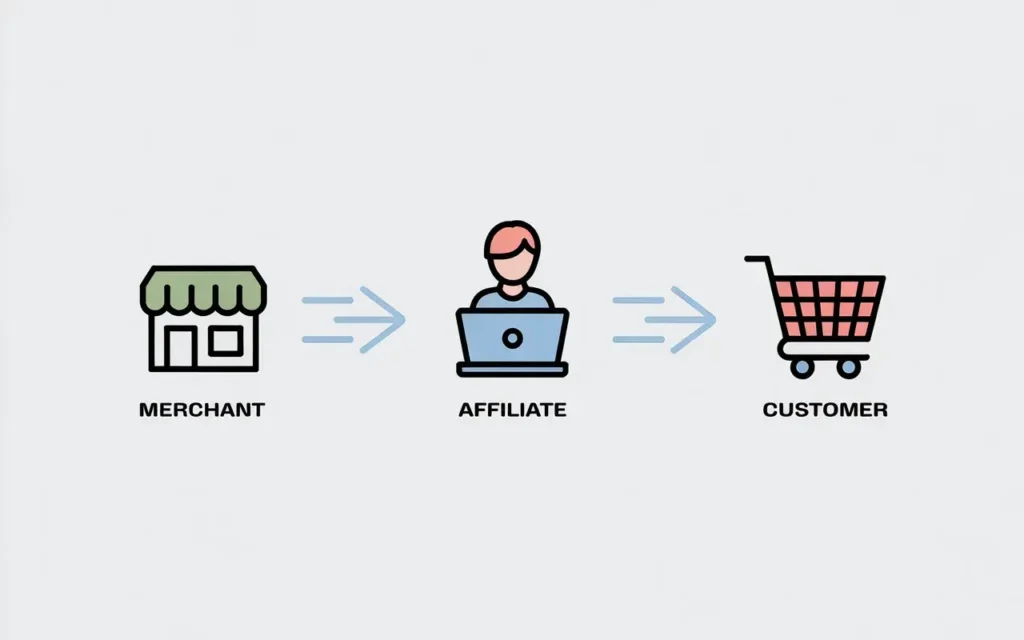
Every affiliate marketing transaction involves three parties. Always. Understanding who they are makes everything else click into place.
The merchant is the company or person who created the product or service. They could be a software company, an online course creator, a retailer, or any business that wants more customers. They set up an affiliate program because they’d rather pay you a commission on a successful sale than spend money on advertising that might not convert.
The affiliate is you. Your job is to share information about the merchant’s product with people who might actually want it. You do this through content you create, whether that’s a blog post, a video, an email, or anything else that puts the right information in front of the right person.
The customer is the person who reads what you wrote, clicks your link, and makes a purchase. They don’t pay extra because they came through you. The merchant simply shares a portion of what they would have earned anyway.
That’s the whole triangle. Merchant creates the product. You connect it to the right audience. Customer buys it. You earn a commission.
What You Actually Do as an Affiliate Marketer
This is where a lot of beginners get confused, so let’s be direct about it.
Your job is not to sell. Nobody wants to feel sold to, and the moment your content starts feeling like a sales pitch, people stop trusting it.
Your actual job is to inform and connect. You help people understand whether a product is right for them. You share what’s good about it, what’s not so good about it, who it works for, and who it doesn’t. When someone reads your content and feels genuinely helped by it, they naturally want to check out what you recommended. That’s when they click your link. That’s when the commission happens.
The best affiliate marketers don’t think of themselves as marketers at all. They think of themselves as people who genuinely know something useful and want to share it.
The Difference Between Recommending and Selling (This Matters)
Here’s something the competitor article and most beginner guides skip entirely: affiliate marketing is not the same as direct selling, and it’s absolutely not the same as an MLM.
In direct selling, you’re pushing a product as your primary goal. In an MLM, you’re often recruited to sell to your personal network and recruit others. Both of those models put the product transaction at the center of everything.
Affiliate marketing puts the reader’s problem at the center.
You start by asking: what does this person need to know? What are they trying to figure out? What decision are they trying to make? Your content answers those questions honestly. The product recommendation happens naturally because it’s genuinely the right answer to the problem you just helped them understand.
Companies offer affiliate programs for a very practical reason. Paid advertising is expensive and unpredictable. Paying a commission only when a sale actually happens is far more efficient for them. They get guaranteed return on investment. You get rewarded for results. It’s a model that works because everyone benefits when it’s done right.
That’s the foundation. Everything else in affiliate marketing builds on this.
The Affiliate Marketing Ecosystem — How All the Pieces Connect
How the Money Actually Flows (From Customer to Your Pocket)
Let’s walk through exactly what happens when you earn an affiliate commission, step by step, so there’s no mystery left in the process.
You create a piece of content. A blog post, a video, an email, whatever your platform is. Inside that content, you include a special link that’s unique to you. A reader finds your content, reads it, and clicks that link. They land on the merchant’s website. They decide to buy. The merchant records that the sale came from your unique link. They calculate your commission. At the end of the payment period, usually monthly, they transfer that amount to you.
That’s the full journey. From the moment someone reads your content to the moment money lands in your account, every step happens because of that unique link. The link is the engine of the whole system.
What Affiliate Programs Are and How They Work
An affiliate program is simply an arrangement a company sets up to pay people like you for sending them customers. When you join an affiliate program, you get access to your unique tracking links, information about commission rates, and usually some marketing materials to help you promote their product.
You apply, get accepted, receive your links, and start creating content that includes those links. When someone converts through your link, the program tracks it and records the commission in your account.
Some programs are run directly by the company themselves. You go to their website, find an “Affiliates” or “Partners” link usually in the footer, apply directly, and work with them one-on-one. Amazon Associates is the most well-known example of this. Many software companies and course creators also run their own programs this way.
The advantage of direct programs is that you often get a closer relationship with the company, better communication, and sometimes negotiated commission rates once you’re sending consistent traffic.
The downside is that you have to find and manage each program separately, which gets complicated fast when you’re promoting multiple products.
What Affiliate Networks Are — and Why They’re Different
An affiliate network sits in the middle between you and many different companies at once. Instead of applying to twenty different programs individually, you join one network and get access to hundreds or even thousands of programs all in one place.
Think of it like a marketplace. On one side, you have companies who want affiliates to promote their products. On the other side, you have affiliates like you who want to find products to promote. The network connects you, handles tracking, manages payments, and gives you one dashboard to see everything.
The advantage of networks is convenience and variety. You can search for products in your niche, compare commission rates, and switch between programs without juggling a dozen separate logins.
The thing to know is that networks add a layer between you and the merchant, which can sometimes mean slower support or less flexibility. For beginners, though, networks are usually the easier starting point because everything is centralized.
How Tracking Works: The Cookie Explained in Plain Language
Here’s where a lot of beginners feel intimidated. The word “cookie” sounds technical. It’s actually incredibly simple.
Imagine you give someone a business card with your name on it. They put it in their wallet and forget about it. Two weeks later, they need the service you offer, find that card, and call you. You get credit for the referral because your card was there.
A cookie works exactly like that, except it lives in someone’s internet browser instead of their wallet. When someone clicks your affiliate link, a tiny file gets stored in their browser with your affiliate ID inside it. If they make a purchase later, the merchant’s system reads that file, sees your ID, and credits you with the commission.
The customer doesn’t see it. It doesn’t slow down their computer. It’s just a quiet record in the background that says “this person came from this affiliate.”
Cookie Duration: Why It Matters and When It Doesn’t
Cookie duration is how long that record stays in someone’s browser before it expires. Programs vary enormously on this.
Some programs give you 24 hours. If the person doesn’t buy within that window, your cookie expires and you earn nothing even if they come back and purchase a week later. Amazon Associates runs on a 24-hour cookie, which is famously short.
Other programs offer 30, 60, or 90 days. Some give you a full year. A few run on lifetime cookies, meaning you get credit for any purchase that person ever makes through your link.
Longer cookies are better because people rarely buy immediately. Most people research a purchase over days or weeks. A 30-day cookie gives you a genuine chance to earn the commission when they finally decide.
That said, don’t let cookie duration be the only thing you evaluate when choosing a program. A great product with a 24-hour cookie will often outperform a mediocre product with a 90-day cookie, because people who truly want something buy quickly.
The Two Main Commission Structures Beginners Need to Know
Pay-per-sale is the most common model. You earn a percentage of the sale price whenever someone buys through your link. This is what most people picture when they think of affiliate marketing. Commission rates vary hugely by industry — physical products often pay 3% to 10%, while digital products and software can pay 20% to 50% or even more.
Pay-per-lead means you earn a commission when someone takes a specific action short of buying — signing up for a free trial, submitting a form, creating an account, or subscribing to an email list. The commission per lead is usually smaller than a sale commission, but these can convert more easily because you’re not asking someone to spend money.
Pay-per-click is less common but exists in some programs. You earn a small amount every time someone clicks your link, regardless of whether they buy. The rates are very low, and you need serious traffic volume to make meaningful money this way. Most beginners don’t need to focus here.
There’s one more structure that most beginner guides, including the competitor article, completely ignore.
Recurring commissions are the most powerful structure in affiliate marketing. Some programs, especially software subscriptions and membership sites, pay you every single month for as long as the customer you referred keeps their subscription active. You refer someone once and earn from that referral for months or years. One good piece of content promoting the right recurring-commission program can quietly build a base of reliable monthly income that grows as you add more referrals over time. If you’re ever choosing between two otherwise equal programs, the one with recurring commissions wins almost every time.
Choosing Your Niche: The Decision That Determines Everything

Most beginner guides to affiliate marketing skip straight to “join these programs and start posting links.” They assume you already know what you’re about, what you want to write about, and who you’re writing for.
That assumption leaves a lot of beginners completely stuck.
Your niche is the foundation of everything. Get it right and building your affiliate income becomes a focused, manageable process. Get it wrong and you’ll spend months creating content that goes nowhere, promoting products to an audience that doesn’t care, and wondering why nothing seems to work.
Why Your Niche Choice Affects Your Income Ceiling
Not all niches are created equal, and that’s not a depressing truth — it’s actually useful information.
Some niches have enormous audiences but very few affiliate programs with meaningful commissions. Some niches have incredible affiliate programs but tiny audiences that are hard to reach. The sweet spot is a niche where a real, searchable audience exists, genuine affiliate programs are available, and you can consistently create content without running dry after three posts.
Your niche also determines how quickly you can grow. A focused niche builds authority faster than a broad one. When you write specifically about budgeting for freelancers, you become the go-to person for that audience far quicker than if you write generally about “personal finance.” Specificity is what turns casual visitors into loyal readers who actually trust your recommendations.
The Three Types of Niches (and Which One Is Right for You)
When you’re thinking about what niche to choose, most options fall into one of three categories.
Passion niches are topics you genuinely love and could talk about for hours without getting bored. The advantage here is that content creation feels sustainable because you actually care about the subject. The risk is that passion alone doesn’t guarantee an audience or profitable affiliate programs, so you need to check that the other elements are also present.
Expertise niches are topics where you have real knowledge, experience, or a professional background. If you’ve spent years working in HR, writing about career development comes naturally. If you’ve paid off significant debt, writing about debt management carries authentic credibility. Expertise niches build trust quickly because your experience comes through in how you write.
Problem-solving niches focus on a specific pain point a specific group of people has. Weight loss, getting out of debt, learning a new skill, growing a small business — these niches are powerful because the audience is already motivated. They’re not browsing casually. They’re actively searching for answers. That intent translates into stronger conversion rates for affiliate products.
You don’t have to fit neatly into just one category. The best niches usually combine at least two.
High-Commission Niches vs. High-Volume Niches
Here’s a distinction that changes how you think about earning potential.
High-commission niches pay well per sale but usually have smaller audiences. Personal finance, software and SaaS tools, web hosting, insurance, and online education fall into this category. A single referral in some of these niches can earn you $50, $100, or even $200. You don’t need massive traffic to earn meaningfully.
High-volume niches have enormous audiences but typically lower commission rates per sale. Fashion, beauty, home goods, and general lifestyle content work this way. You might earn $3 to $8 per sale, which means you need a lot of people clicking and buying before the numbers get interesting.
Neither model is better in absolute terms. But for beginners who are still building traffic, high-commission niches tend to show results faster because each conversion carries more weight.
The Interest-Demand-Profit Test: How to Evaluate a Niche Before Committing
Before you commit to any niche, run it through these three questions.
Is there a real audience actively searching for this? Go to Google and type in topics related to your niche idea. If the search suggestions are rich and relevant, people are looking. If the results are thin or the topic is too obscure, the audience may be too small to sustain a content business.
Are there solid affiliate programs in this space? Search for “[your niche topic] affiliate program” and see what comes up. If you find multiple reputable companies with affiliate programs offering decent commissions, that’s a green flag. If you struggle to find even two or three, that’s a warning sign.
Can you create enough content on this topic without exhausting it in a month? Some niches sound interesting but are actually very narrow. A niche needs to support dozens, eventually hundreds, of different content pieces. If you can brainstorm 30 or 40 article or video ideas without straining, you’re in good shape.
Niches That Tend to Pay Well in Affiliate Marketing
Certain categories consistently attract strong affiliate programs and motivated buyers. These aren’t the only options, but they’re a reliable starting point for research.
- Personal finance: budgeting, saving, investing, debt payoff, credit cards, banking
- Health and wellness: fitness, mental health, nutrition, sleep, supplements
- Software and digital tools: productivity apps, project management software, marketing tools, website builders
- Online education and careers: course platforms, skill-building, freelancing, remote work
- Home and lifestyle: home improvement, organization, sustainable living, parenting
These categories pay well because the products solve real problems people spend real money on, and because companies in these spaces have figured out that affiliate marketing works for them.
The Mistake of Choosing a Niche Based on What’s “Trendy”
Every few months, a new niche explodes in popularity and suddenly everyone wants in. The problem with chasing trends is that by the time you build a meaningful presence in a trendy niche, the trend has usually peaked and the space is saturated with people who got there before you.
A far better strategy is to choose a niche with enduring demand. People will always need help with money. They’ll always want to get healthier. They’ll always be looking for tools that make their work easier. These needs don’t expire with a news cycle.
Trendy niches can work, but only if you genuinely care about the topic and plan to stay in it long-term. Jumping in because something is hot right now, without real interest or knowledge, almost always leads to burnout and abandoned projects.
What To Do If You’re Interested in Multiple Topics
This is genuinely one of the most common struggles beginners face. You’re interested in personal finance AND fitness AND travel AND productivity, and you can’t figure out which one to pick.
Here’s the most honest advice: pick one and start. Not forever. Just for now.
You can always expand or pivot later once you have some experience and data about what resonates with an audience. Starting with two or three niches at once means spreading your effort so thin that none of them gets the attention needed to grow.
If two niches feel truly equal, ask yourself which one you’d want to write about if nobody was reading and no money was coming in yet. Because in the early months, that’s exactly what it’ll feel like. The niche that still excites you in that scenario is the right one to start with.
The Platforms That Work for Affiliate Marketing — Your Honest Options
The competitor article makes a strong case for blogging and then mostly dismisses other platforms. That’s not bad advice — but it’s incomplete advice.
The reality is that different platforms suit different people, different niches, and different working styles. Your job isn’t to follow what someone else found successful. Your job is to find the platform that actually fits how you work, because that’s the one you’ll stick with long enough to see results.
Here’s an honest look at every major option.
The Blogging Path: Why It’s Still One of the Strongest Options
A blog built on search engine optimization is still one of the most powerful long-term vehicles for affiliate marketing income. When someone types a question into Google and lands on your article, they’re already interested in the topic. That intent makes them far more likely to click an affiliate link and follow through on a purchase.
Long-form written content converts well because it gives you room to explain, compare, and genuinely help the reader make a decision. A 1,500-word post reviewing a product answers the questions a potential buyer actually has. A short Instagram caption doesn’t.
The trade-off is time. Organic search traffic takes months to build. You’ll write content for weeks or months before Google sends you meaningful visitors. That’s not a reason to avoid it — it’s just something to plan for mentally and financially before you start.
A realistic timeline for a new blog to earn its first affiliate commission through search traffic is somewhere between three and nine months, depending on your niche, how consistently you publish, and how well you understand keyword research.
YouTube and Video Content: The Visual Alternative
If the idea of writing hundreds of articles makes you want to close this tab, YouTube might be your platform.
Video builds trust at a speed that text struggles to match. When someone watches you explain something, demonstrate a product, or walk through a tutorial, they feel like they know you. That relationship converts into affiliate clicks more readily than a stranger’s blog post.
Affiliate links on YouTube live in the video description. You mention the product or tool during the video, direct viewers to the link in the description, and earn commissions when they buy. This works especially well for tech reviews, software tutorials, personal finance walkthroughs, and any product that benefits from a visual demonstration.
The barrier people worry about with YouTube is production quality. You don’t need a studio setup. Many successful affiliate YouTube channels started with a phone, decent lighting from a window, and a cheap external microphone. The content matters far more than the equipment.
The timeline to earning on YouTube is somewhat faster than blogging for some creators, because good videos can gain traction through YouTube’s recommendation algorithm even without an existing audience.
Email Marketing as an Affiliate Channel: Underrated and Underused
Here’s something most beginner guides don’t tell you loudly enough: your email list is the most valuable asset you can build as an affiliate marketer.
Every other platform — Google, YouTube, Instagram, Pinterest — can change its algorithm, restrict your reach, or disappear entirely. Your email list belongs to you. Nobody can take it away. And email converts at a higher rate than almost any other channel because the people on your list already chose to hear from you.
You build an email list by offering something useful in exchange for someone’s email address. A free guide, a checklist, a mini-course, a template — whatever your audience would find genuinely helpful. You then send them regular, valuable content, and within that content you occasionally recommend affiliate products that are genuinely relevant to them.
The key word there is genuinely. An email list that trusts you is worth far more than a large one that finds you pushy. When you promote something by email, it should feel like a friend’s recommendation, not a broadcast advertisement.
Even if you blog or create YouTube videos, building an email list alongside your main platform turns your one-time visitors into a reliable, returnable audience.
Social Media for Affiliate Marketing: What Works and What Doesn’t
Social media gets a bad reputation in affiliate marketing circles, often unfairly. The truth is more nuanced.
Social media rarely converts well as a standalone affiliate channel. Posting an affiliate link on Instagram or X and hoping people click and buy almost never works, for a simple reason: people on social media are in browsing mode, not buying mode. They’re not looking for answers to a specific question. They’re scrolling. Interrupting that scroll with a product recommendation rarely leads to a purchase.
Where social media genuinely works is as a traffic driver to your real conversion platform. A Pinterest pin that leads to your blog post. A TikTok video that sends people to your YouTube channel. An Instagram story that directs followers to a link in your bio leading to a detailed review.
Different platforms suit different niches:
- Pinterest works exceptionally well for lifestyle, home, food, fashion, and personal finance content. It functions more like a search engine than a social network, which means your content has a longer shelf life.
- LinkedIn is powerful for B2B software, career development, and professional tools.
- TikTok can drive significant traffic quickly for trending products, but the audience is often less purchase-ready than search traffic.
- Instagram works well for visually driven niches where the product itself is part of the lifestyle being shown.
Think of social media as your amplifier, not your foundation.
Which Platform Should You Start With? A Simple Decision Framework
Before you decide anything, answer these three questions honestly.
How do you naturally prefer to communicate? If you love writing and research, start a blog. If you’re comfortable on camera and naturally expressive, start a YouTube channel. If you have an existing audience somewhere, start there. Fighting against your natural style is one of the fastest paths to burnout.
How quickly do you need to see results? Blogging is slower but more stable. YouTube can move faster. Email is the most reliable but needs to be built alongside something else. If you need income in the next 30 days, affiliate marketing might not be your fastest path regardless of platform.
What does your niche audience actually use? The best platform is where your target reader already hangs out. Personal finance readers often find content through Google search. Beauty and lifestyle audiences live on Instagram and Pinterest. Tech audiences watch YouTube. Go where your audience already is.
You don’t need to be everywhere. Pick one platform, commit to it long enough to actually learn it, and add a second only after the first is working.
Finding and Joining Affiliate Programs That Are Worth Your Time
Most beginner guides do one thing here: list affiliate networks. Join these five, they say, and go find something to promote.
That’s not bad advice, but it leaves out the most important skill you can develop as an affiliate marketer — knowing how to evaluate a program before you commit your time to promoting it.
What to Look for Before Joining Any Affiliate Program
Not every affiliate program deserves your effort. Some programs have great products but terrible tracking. Some pay high commissions on products nobody actually wants to buy. Learning to evaluate programs independently means you never have to rely on someone else’s list again.
Here’s what actually matters.
The Six Numbers That Tell You If a Program Is Worth It
1. Commission rate. This is the percentage of the sale you earn. For physical products, 5% to 10% is typical. For digital products and software, 20% to 50% is common. For high-ticket items, even a small percentage can be meaningful. Don’t evaluate the rate in isolation — always consider it alongside the product’s price.
2. Cookie duration. You already know what this means from the earlier section. As a benchmark, anything under 30 days deserves extra scrutiny. 60 to 90 days is solid. Lifetime cookies are rare but excellent when you find them.
3. Payment threshold and method. Some programs won’t pay you until you’ve accumulated $100 in commissions. Some only pay by check. Others use PayPal, direct deposit, or bank transfer. Know when and how you’ll get paid before you commit time to promoting something.
4. Product reputation. Search for the product outside of the affiliate program’s own marketing. What do real customers say? Are there complaints about poor quality, bad customer service, or billing issues? A high commission rate on a product people return and resent is not actually a good deal for you.
5. EPC (earnings per click). This stands for earnings per click and tells you how much, on average, affiliates earn each time someone clicks their link. Networks often display this number. A higher EPC suggests the product converts well. A very low EPC in a high-commission program means the traffic isn’t converting, which is a red flag.
6. Affiliate support quality. Does the program have a dedicated affiliate manager you can contact? Do they provide marketing materials, product updates, and performance data? Strong support often indicates a company that takes its affiliate program seriously and treats affiliates as partners rather than afterthoughts.
Where to Find Affiliate Programs in Your Niche
You don’t have to wait for programs to find you. Here’s how to actively seek them out.
- Search inside affiliate networks. Once you join a network, use their search function to find programs in your niche category. Filter by commission rate, EPC, and cookie duration.
- Search Google directly. Type the name of any product you already use or respect, followed by “affiliate program.” You’ll often find programs that aren’t listed on any network because they run independently.
- Check what you already use. The tools, apps, and services you pay for personally are often your best affiliate opportunities. You already know the product, you already trust it, and your genuine enthusiasm comes through in how you write about it.
- See what other creators in your niche promote. Read popular blogs in your space and notice which affiliate links appear repeatedly. If multiple respected creators are promoting the same product, it usually means the product converts and the program is reliable.
Major Affiliate Networks: What Each One Is Best For
Networks vary significantly in what they specialize in, and knowing the difference saves you time.
Large general networks like ShareASale and CJ Affiliate (Commission Junction) host thousands of programs across dozens of categories. They’re a good first stop for any niche because the variety is enormous.
Software-specific networks like PartnerStack and Impact specialize in SaaS and digital tools. These programs typically pay higher commissions, often recurring, making them especially attractive for content creators in the tech, business, and productivity spaces.
Finance-specific networks focus on financial products — credit cards, loans, banking apps, and investment platforms. These tend to carry some of the highest per-lead and per-sale commissions available anywhere in affiliate marketing.
Physical product networks like Amazon Associates give you access to virtually any physical product imaginable. Commissions are lower, but the conversion rate benefits from Amazon’s enormous consumer trust.
Direct Programs vs. Network Programs: Which Should You Choose?
Direct programs often pay higher commissions because they don’t share a cut with a network. They also tend to offer closer relationships with the company, which can lead to better support and sometimes custom commission arrangements as you grow.
Network programs are easier to manage when you’re starting out because everything is centralized. One login, one payment system, one reporting dashboard.
The practical answer: start with networks to find and test programs, then consider moving to direct relationships with your best-performing merchants once you’re sending consistent traffic.
How to Apply and Get Approved (Even as a Beginner With No Traffic)
Some programs have minimum traffic requirements. Many don’t. Here’s how to improve your approval odds regardless of where you’re starting.
Make sure your blog or platform looks professional before you apply. A clean, organized website with at least a few published pieces of content signals that you’re serious. Programs reject applications from empty sites because they have no evidence you’ll actually promote anything.
When the application asks how you plan to promote their product, be specific. “I write personal finance content targeting young professionals and I plan to write a detailed review and include your product in a comparison post” is far more compelling than “I will promote on my blog and social media.”
If you get rejected, don’t panic. Some programs auto-reject new applicants and accept you later when you reapply with more content. Others are genuinely open to beginners if you reach out directly to their affiliate manager and make your case personally.
One Thing to Check Before Promoting Any Product
Before you write a single word promoting any product, ask yourself honestly whether you would recommend it to a close friend.
Not because you’re earning a commission. Not because the payout is attractive. Because you genuinely believe it would help them.
This isn’t just ethical advice — it’s strategic. Your audience can sense the difference between authentic recommendation and paid promotion dressed up as one. When you promote products you actually believe in, your writing carries conviction. Readers feel that. They click. They buy. They trust you enough to come back.
When you promote something just for the commission, that also comes through. Readers might not be able to name exactly what feels off, but they don’t click, and over time they stop trusting your recommendations entirely.
Your credibility with your audience is worth more than any single commission. Protect it like it’s the most valuable asset you have — because in affiliate marketing, it is.
Creating Content That Actually Converts — The Strategy Behind Affiliate Marketing Success

Here’s the thing most affiliate marketing guides skip entirely: joining programs and getting approved is the easy part. The hard part, the part that actually determines whether you earn anything, is creating content that makes people genuinely want to click your links and buy.
The competitor article never touches this. It tells you to create content but never explains what kind, how to structure it, or why some content earns while most doesn’t. This section fixes that completely.
Why Most Affiliate Content Fails Before Anyone Reads It
Most affiliate content fails for the same predictable reasons, and none of them are complicated.
The tone feels promotional. Readers can sense when they’re being sold to. The moment your writing starts sounding like a product brochure, trust evaporates. People don’t click affiliate links because they felt marketed at. They click because they felt genuinely helped.
There’s no real perspective behind it. Generic content that describes a product the same way the product’s own website does adds nothing. Readers don’t need a restatement of the sales page. They need someone who actually understands the product to tell them honestly whether it’s worth their money.
Links appear without context. Dropping an affiliate link into a paragraph without explaining why you’re recommending it feels jarring and transparent. Every link you include should feel like a natural next step for a reader who just found something useful in your content.
Keyword stuffing kills the reading experience. Writing a sentence that sounds tortured just to include a keyword phrase hurts both your reader and your search rankings. Readability always comes first.
The Content Types That Consistently Drive Affiliate Commissions
Some content formats convert far better than others. Here’s what actually works.
In-depth product reviews are the backbone of affiliate marketing. A thorough, honest review of a single product targets readers who are already close to making a purchase decision. They’ve done their initial research. Now they want to know if this specific product is actually worth it. Your job is to answer that question with more honesty and detail than any other review they’ll find.
Comparison articles are among the highest-converting formats that exist in affiliate marketing. “Product A vs. Product B: Which One Is Actually Better?” captures readers who have narrowed their choices and just need a final push in one direction. These convert so well because the reader’s intent is crystal clear. They’re ready to buy. They just want someone to help them choose.
Best-of roundups work particularly well for gift guides, tools lists, and “top products for [specific situation]” articles. “Best budgeting apps for college students” pulls in a specific audience with a specific need, and you can include multiple affiliate links naturally within a single piece of content.
How-to tutorials that naturally lead to a product are powerful because they build trust first. You’re helping someone accomplish something real, and the product recommendation arrives as a useful tool, not as an advertisement.
Personal experience posts carry enormous weight when done honestly. “I used this budgeting app for three months and here’s what happened” is infinitely more persuasive than any amount of generic description.
How to Write a Product Review That People Actually Trust
A review that readers trust has a specific structure, and it’s not complicated.
Start with who the product is actually for. Before you say anything else, tell the reader in plain terms what kind of person this product suits and what problem it solves. This immediately signals that your review is honest rather than promotional.
Cover real pros and real cons. Nothing destroys a review’s credibility faster than a list of benefits with zero drawbacks. Every product has limitations. Naming them honestly makes everything else you say more believable. When you acknowledge a flaw and still recommend the product, readers understand that it genuinely outweighs the downside in your assessment.
Use specific details instead of vague praise. “The interface is clean and easy to navigate” tells the reader nothing. “You can set up your first budget in about eight minutes without reading any instructions” tells the reader something real.
End every review by being honest about who shouldn’t buy this product. This is the move that separates genuine reviews from promotional ones, and readers recognize and appreciate it immediately.
The Comparison Article: One of the Highest-Converting Formats in Affiliate Marketing
Comparison articles deserve their own spotlight because beginners consistently underestimate them.
When someone searches “Product A vs. Product B,” they’re not in the early stages of research. They’re close to a decision. Your comparison article meets them exactly where they are. You’re not convincing them that they need a product. They already know they do. You’re simply helping them choose.
Structure your comparison around what actually matters to the reader: price, features that affect daily use, who each option suits better, and a clear bottom-line recommendation. Don’t try to stay perfectly neutral. Readers want your honest opinion. Give them one.
You can include affiliate links to both products if both programs are available to you. This way you earn regardless of which direction the reader goes, as long as they found your article genuinely helpful.
Listicles, Gift Guides, and Round-Ups: When and How to Use Them
These formats work brilliantly for certain situations and poorly for others.
They work well when the reader wants options rather than a single answer. “Best productivity tools for remote workers” serves someone who knows they need help but hasn’t committed to any specific solution. Give them five to ten genuinely good options, explain each one honestly, and let them self-select.
They work poorly when they’re just lists of products with no real explanation or perspective. A roundup that reads like a product catalog adds nothing. Every item in your list needs a real reason for being there and a real description of who it’s best for.
Gift guides perform especially well around seasonal search spikes. If your niche has seasonal relevance, publishing gift guides a few weeks before major holidays can drive significant traffic and commissions.
How to Naturally Embed Affiliate Links Without Sounding Like an Ad
Link placement matters more than most beginners realize.
Don’t save all your links for the end. Readers who find your content useful and click away before finishing will never see a link buried in your conclusion. Place your first relevant affiliate link early, in a context where it genuinely makes sense.
Use anchor text that reads naturally. “Click here” and “buy now” scream advertisement. Anchor text like “this budgeting app” or “the tool I use for tracking expenses” integrates seamlessly into the surrounding sentence and doesn’t interrupt the reading experience.
Two to four links per post is usually appropriate for most affiliate content. More than that starts to feel cluttered and promotional. Each link should appear in a context where the recommendation makes natural sense, not just wherever you can fit one.
The Role of SEO in Making Your Content Discoverable
Creating great content that nobody finds is a frustrating and avoidable problem.
Keyword intent is the concept that changes everything. Every search query has an intent behind it. Someone searching “what is affiliate marketing” wants information. Someone searching “best affiliate programs for beginners” is closer to taking action. Someone searching “ShareASale vs. CJ Affiliate” is practically ready to sign up for one of them.
Informational keywords bring readers who are learning. Commercial keywords bring readers who are deciding. For affiliate content, you want a healthy mix of both, with more emphasis on commercial intent keywords where your affiliate links are most relevant.
Finding keywords with buying intent is straightforward. Look for phrases that include words like “best,” “review,” “vs,” “alternative,” “for beginners,” or “worth it.” These signal that the searcher is evaluating options, not just exploring a topic.
Internal linking between your own affiliate content pieces tells search engines that your content is organized and interconnected, which helps your rankings. It also keeps readers on your site longer by guiding them naturally from one helpful piece to the next.
How to Write for Both Search Engines and Real People
This sounds like it requires balance, but it actually doesn’t. Good content for real people is good content for search engines. The conflict only arises when you start trying to optimize for algorithms instead of humans.
Write in natural language. Explain things clearly. Answer the actual question the reader came with. Cover related questions they probably have. Use your keywords when they fit naturally, and skip them when they don’t.
The single most useful test: read your content out loud. If any sentence sounds unnatural when spoken, it needs to be rewritten. Sentences that read awkwardly don’t just hurt the reader experience. They signal to search engines that the content feels manufactured rather than genuine.
Search engines have gotten remarkably good at recognizing genuinely helpful content. The best SEO strategy available to you is simply to write something that truly helps your reader. Everything else follows from that.
Getting Traffic: How to Make Sure People Actually See Your Content
You can write the most helpful affiliate content in your niche. If nobody finds it, it earns nothing.
Traffic is the fuel that makes affiliate marketing work, and yet the competitor article never explains how to get it. It mentions that you need traffic, acknowledges you don’t need 50,000 monthly page views, and then moves on without giving you any actual guidance on how to build an audience. That gap stops here.
Why Traffic Is the Variable That Determines Your Income
Everything else in affiliate marketing, your niche, your programs, your content quality, multiplies based on traffic. A perfectly written review earning 2% commissions on a $100 product needs a meaningful number of readers to generate real income. Without traffic, even the best content sits silently in the corner.
The good news is that you don’t need enormous traffic to start earning. You need the right traffic. A thousand readers who are actively searching for exactly what you wrote about will consistently outperform ten thousand casual browsers who stumbled across your page.
Traffic quality always matters more than traffic quantity. This is the insight that reframes everything. Your goal isn’t just to get visitors. It’s to attract the specific people who are already interested in what you’re recommending.
Organic Search Traffic: The Long-Term Foundation
Search traffic is the most valuable traffic source for most affiliate marketers because of one simple fact: it comes pre-qualified.
When someone types a specific question into Google and lands on your article, they’ve already told you exactly what they want to know. That level of intent converts to affiliate clicks far better than someone who found you through a random social media scroll.
The trade-off is time. Organic search results don’t happen overnight. A realistic expectation for a brand-new website is three to six months before Google starts sending meaningful traffic, and that assumes you’re publishing consistently and targeting the right keywords.
This timeline discourages a lot of beginners. Don’t let it discourage you. The traffic that eventually comes from search is compounding. An article that ranks well in month six keeps earning traffic in month eighteen, and in month thirty, without you doing anything additional to maintain it. That’s the long-term power of SEO-driven content.
Pinterest as a Traffic Source: Especially Powerful for Certain Niches
Pinterest is one of the most misunderstood platforms for affiliate marketing, and beginners consistently underestimate it.
Pinterest behaves more like a search engine than a social network. People go to Pinterest with specific intentions: they’re planning a kitchen renovation, looking for budget meal ideas, searching for home office setups. They’re not mindlessly scrolling in the same way they might on Instagram. That intent makes Pinterest traffic significantly warmer than typical social media traffic.
Niches that perform especially well on Pinterest include personal finance, home and lifestyle, food and recipes, parenting, beauty, and DIY projects. If your niche has a strong visual component or attracts people who are planning and organizing their lives, Pinterest deserves serious attention.
You drive Pinterest traffic by creating visually appealing pins that link directly to your blog posts. Each pin acts like a small advertisement for your content. Unlike Instagram posts, Pinterest pins don’t disappear from view after a few days. A strong pin can continue driving traffic for months or years after you publish it.
Email Traffic: The Audience You Actually Own
Every other traffic source involves a platform you don’t control. Google can update its algorithm. Pinterest can change how it distributes content. Social media reach can evaporate overnight. Your email list belongs entirely to you, and nobody can take it away.
An email list is the most reliable traffic source in affiliate marketing, and building one from the beginning puts you in a fundamentally stronger position than someone who relies entirely on search or social media.
You build a list by offering something genuinely useful in exchange for an email address. This is called a lead magnet. It doesn’t have to be complicated. A one-page checklist, a simple template, a short email course, or a curated resource guide all work well. The key is that it must deliver real value to your specific audience immediately.
Once someone joins your list, you send them regular content they actually want to read. Within that content, you occasionally recommend affiliate products that genuinely fit their situation. Because they chose to hear from you and already trust your perspective, they convert at significantly higher rates than cold traffic from search or social media.
Social Media Traffic: How to Use It as a Feeder, Not a Foundation
Social media traffic is real, and it’s worth pursuing. But you need the right mental model for how it works.
Social media is an awareness tool, not a conversion tool. People scrolling through their feeds aren’t in buying mode. They’re in browsing mode. Posting an affiliate link directly on social media and expecting purchases is like setting up a shop in a park and hoping joggers stop to buy something. It occasionally works. It’s not a strategy.
What social media does well is introduce your content to new people. A short video clip that teases a useful insight drives people to your full article. A quote from your blog post creates curiosity that leads people to read the whole thing. A personal story shared on your profile builds connection that eventually leads people to your email list.
Use short-form content on social media to drive people toward your long-form affiliate content elsewhere. That’s the model that works.
The Compound Effect: How Traffic Builds Over Time
One of the most encouraging things about building affiliate marketing traffic is that your efforts compound.
Each article you publish adds to your total footprint in search results. Each email subscriber you gain represents a permanent connection you can activate whenever you publish something new. Each Pinterest pin you create potentially drives traffic for years. Each YouTube video you upload keeps earning views indefinitely.
In the early months, growth feels slow because you’re building the foundation. But the compounding effect means that month twelve looks dramatically different from month three, not because you worked harder, but because everything you did in months one through eleven is still working alongside what you’re doing now.
Think of each piece of content as a small permanent asset. You create it once. It keeps working after you’ve moved on to the next thing. That’s the real mechanism behind what people call “passive income” in affiliate marketing.
How Much Traffic Do You Actually Need to Start Earning?
The honest answer is: less than you think, if your traffic has strong buyer intent.
A blog with 2,000 monthly visitors who found you by searching for a specific product review can consistently outperform a blog with 20,000 monthly visitors who arrived through a viral social media post.
As a rough benchmark, if you’re attracting readers through search traffic in a niche with solid affiliate programs, you can start seeing your first commissions with as few as 500 to 1,000 monthly visitors. Your first $100 might come from there. Your first $500 probably requires something closer to 5,000 to 10,000 monthly visitors, depending heavily on your niche and commission rates.
These numbers vary widely, so treat them as orientation rather than guarantees. The point is that you don’t need to build a massive audience before affiliate marketing becomes viable. You need a focused, intentional audience. That’s a much more achievable target.
How Much Can You Realistically Earn — Real Numbers, Real Timelines, No Fairy Tales
The competitor article shares impressive income screenshots and a range from $0 to $50,000 a month, which is technically accurate but practically useless for a beginner trying to understand what they’re working toward.
What you actually need is a framework. A map of where you are, what comes next, and what it realistically takes to move from one stage to the next. That’s what this section gives you.
Why Affiliate Income Is Impossible to Predict Exactly
Anyone who gives you a precise income projection for affiliate marketing is either guessing or selling you something. The variables involved are simply too numerous and too personal to produce reliable specific numbers.
Your niche, your platform, your traffic quality, the programs you choose, how well your content converts, how consistently you publish, and frankly some timing and luck all combine to produce your actual results. Two people following identical strategies in different niches can produce wildly different outcomes.
What you can predict is the general shape of the journey. The stages are consistent even when the exact numbers aren’t.
The Four Stages of Affiliate Marketer Income
Stage one: The learning phase. Income is zero. This is normal and expected. You’re building the foundational skills — understanding your niche, learning content creation, figuring out SEO basics, joining programs, and developing your own voice. The goal at this stage isn’t income. It’s competence. Rushing past this phase by chasing commissions before you understand the fundamentals is one of the primary reasons beginners quit.
Stage two: The testing phase ($1 to $500 per month). Your first commission arrives. Then a few more. Income is inconsistent and unpredictable, but the fact that it exists proves the model works. This stage is about learning what converts in your specific niche with your specific audience. You test different content formats, different products, different ways of embedding recommendations. You study what earns and do more of it.
Stage three: The growth phase ($500 to $5,000 per month). You’ve identified what works. Now you replicate it intentionally and consistently. Your traffic is growing. Your content library is expanding. Your email list is building. Income climbs more steadily during this phase because you’re no longer experimenting randomly. You’re executing a strategy you’ve validated through real results.
Stage four: The scale phase ($5,000 and beyond per month). You’re reinvesting time and possibly money into systems that extend your reach. You might hire help with content creation or design. You’re diversifying both your traffic sources and your affiliate programs. Income at this stage often starts to feel genuinely stable rather than unpredictable.
What Factors Actually Determine How Much You Earn
Six variables have more influence over your affiliate income than anything else.
Your niche sets the ceiling on what’s possible. High-ticket niches with strong commission rates give you higher earnings per conversion. High-volume niches require more traffic to reach the same numbers.
Traffic quality matters more than traffic volume, as covered in the previous section. A small, highly targeted audience converts better than a large, disinterested one.
Commission rates and structures determine how much each sale is worth. Recurring commissions build a compounding monthly income base that one-time commissions can’t replicate.
Content quality and trust directly affect your conversion rate. Better content, built on real audience trust, converts a higher percentage of your readers into buyers.
Consistency over time is the factor most beginners underestimate. Showing up reliably for twelve months produces results that six months of intense effort followed by burnout never will.
Audience trust level is the cumulative result of everything else. An audience that genuinely trusts you converts at multiples of what a skeptical audience does, regardless of how good your content is on paper.
Why Your First $100 Takes the Longest
The first hundred dollars in affiliate income is disproportionately difficult, and understanding why helps you get through it without losing confidence.
At the start, you have no search rankings, no email list, no social following, and no track record with the algorithms that distribute content. You’re building all of these simultaneously while also learning the skills required to do this effectively. Progress feels slow because you’re doing a lot of foundational work that doesn’t produce visible results until several months in.
Your first commission, whatever its size, is enormously significant. Not because of the money. Because it proves that the system works. Something you wrote convinced a real person to click a link and make a purchase. That’s a repeatable event. Once you’ve done it once, you know you can do it again, and that knowledge changes how you approach everything that follows.
The Difference Between Volatile Income and Stable Income in Affiliate Marketing
Affiliate income fluctuates. Knowing why it fluctuates helps you manage it rather than panic over it.
Seasonality affects most niches. Finance content tends to spike around January when people set budgets and around tax season. Gift and product content spikes around major holidays. If you track your income month over month, you’ll see these patterns repeat predictably.
Program changes can affect your income overnight. Companies adjust commission rates. Some programs shut down entirely. If 80% of your affiliate income comes from a single program, a change to that program’s terms can seriously damage your earnings with no warning.
Diversification is the protection. Spread your affiliate income across multiple programs, multiple products, and multiple traffic sources. No single change should be able to devastate your total income.
When Affiliate Marketing Starts Feeling Like Real Money
This varies by person and by definition, but most affiliate marketers describe a qualitative shift somewhere in the $500 to $1,500 per month range.
At that level, the income is real enough to be meaningful. It’s covering expenses, or supplementing income noticeably, or proving that the effort is genuinely worthwhile. The motivation that comes from reaching this level tends to sustain the momentum needed to keep growing.
Getting to this point typically takes between six and eighteen months for most beginners who start from scratch and work consistently. That’s a wide range, and it reflects the real variation in niches, platforms, and starting conditions. Not a discouraging range. An honest one.
Honest Income Benchmarks by Platform and Niche
These are rough orientation figures, not guarantees. Treat them as a general sense of what’s possible rather than a prediction.
A personal finance blog with 10,000 monthly search visitors and well-placed affiliate links to financial tools can reasonably earn between $500 and $3,000 per month, depending on program quality and conversion rate.
A software or SaaS-focused content site in the business tools space, even with lower traffic volumes, can earn disproportionately well due to high commission rates and recurring structures. $1,000 to $5,000 per month is achievable at relatively modest traffic levels if the content targets commercial keywords effectively.
Physical product niches through Amazon Associates typically require significantly more traffic to produce the same income, given the lower commission rates. The same $1,000 monthly income might require three to five times the traffic compared to a software niche.
The pattern is consistent: higher-value products with higher commission rates let you earn more from less traffic. For beginners who are still building an audience, this makes high-commission niches more forgiving places to start.
Legal, Ethical, and Practical Things You Must Know Before You Start
Nobody talks about this part. Every beginner guide to affiliate marketing covers the exciting stuff — commissions, programs, content strategy — and completely skips the things that can actually get you into legal trouble or cost you money you didn’t expect to owe.
The competitor article doesn’t mention any of this. Not one word about disclosures, taxes, or program terms. That’s a real disservice to beginners who deserve to start this properly. So here’s everything you actually need to know before you promote your first affiliate link.
Why Disclosure Isn’t Optional — It’s the Law
This isn’t a suggestion. It’s a legal requirement.
If you earn money for recommending a product and you don’t tell your reader that you earn money for recommending it, you’re violating consumer protection laws. In the United States, the Federal Trade Commission requires clear and conspicuous disclosure of any material connection between you and the products you promote. Most other countries have equivalent requirements.
The rule exists for a simple reason: readers deserve to know when a recommendation might be financially motivated. You don’t have to apologize for earning commissions. You just have to be upfront about it.
How to Disclose Affiliate Links the Right Way
Disclosure needs to appear where people can actually see it, not buried in your site’s footer or mentioned once on a page nobody reads.
For blog posts, place your disclosure at the top of the article, before any affiliate links appear. A simple, clear statement works perfectly: something like “This post contains affiliate links. If you purchase through my links, I earn a small commission at no extra cost to you.”
For social media posts, disclose within the post itself. A hashtag like #ad or #sponsored works for many platforms, but writing it out in plain language is always safer and clearer.
For email, include disclosure at or near the top of any email that contains affiliate links.
The standard you’re aiming for is simple: a reasonable person reading your content should immediately understand that you may earn something if they click your links. If your disclosure only makes sense to someone who’s looking for it, it’s not conspicuous enough.
The FTC Guidelines Beginners Need to Know (Without the Legal Jargon)
You don’t need a law degree to understand what the FTC expects. The core principle is transparency.
You must disclose any relationship that could affect how readers perceive your recommendations. This includes affiliate commissions, free products you received, or any other compensation. The disclosure must be clear and easy to understand, positioned where readers will see it before they encounter the affiliate links.
What counts as a disclosure that actually protects you? One that’s written in plain language, placed where it’s visible, and doesn’t require the reader to go looking for it.
What doesn’t protect you? A disclosure hidden in a footnote. A disclosure that uses vague language most people wouldn’t recognize. A disclosure that appears after all the affiliate links. If a reader could reasonably claim they didn’t see it or understand it, it probably isn’t sufficient.
If you operate outside the US, look up the advertising disclosure requirements in your own country. The UK, Canada, Australia, and most of Europe have similar frameworks.
Staying Honest With Your Audience: The Long-Term Strategy
Here’s the thing about ethical affiliate marketing: honesty isn’t just morally right. It’s also the most effective long-term business strategy available to you.
Every time you promote something you don’t genuinely believe in, you spend a little bit of the trust your audience placed in you. That trust is a finite and slow-rebuilding resource. One bad recommendation that costs your reader money or disappoints them can undo months of credibility you worked to establish.
The long-term cost of a single dishonest recommendation can far exceed the commission you earned from it. A reader who feels misled doesn’t just stop trusting your affiliate links. They stop reading your content entirely. They tell others. In a world where your reputation is your primary asset, that cost is enormous.
When a high-paying affiliate program reaches out to you for a product you don’t actually believe in, saying no is a completely valid business decision. Protecting your relationship with your audience protects your income more reliably than any single commission ever could.
Affiliate Marketing and Taxes: What to Keep Track of From Day One
Affiliate commissions are income. In virtually every country, income gets taxed. This surprises exactly no one in theory, but a surprising number of beginners treat affiliate earnings as bonus money and don’t think about taxes until it’s too late.
Start keeping records from the moment you earn your first commission. Track every payment you receive, which program it came from, and when it arrived. Most affiliate networks provide payment summaries, but don’t rely solely on their records. Keep your own.
The good news is that running an affiliate marketing business also means you have legitimate deductible expenses. Web hosting, domain registration, tools you use for content creation, courses you take to improve your skills, and potentially a portion of your home internet costs can all qualify as business expenses in many tax systems. These deductions reduce your taxable income, so tracking them from the start saves you real money.
Depending on where you live and how much you earn, you may need to make estimated quarterly tax payments rather than waiting until year end. Missing these payments can result in penalties.
One firm note here: this is general information, not tax advice. Tax rules vary significantly by country, state, and individual situation. Once your affiliate income becomes meaningful, speaking with a local accountant or tax professional is worth every cent of the fee.
Protecting Yourself: Terms and Conditions You Should Read
Every affiliate program you join has a terms and conditions document. Most beginners never read it. That’s a mistake that can cost you all the earnings you’ve accumulated.
Programs can ban affiliates for violating their terms, and when that happens, any unpaid commissions typically disappear along with your account.
The violations that get affiliates removed most commonly include:
- Cookie stuffing: artificially inflating your referrals by placing tracking cookies without the user actually clicking your link. This is both a terms violation and potentially illegal.
- Incentivized clicks: offering rewards, discounts, or giveaways in exchange for people clicking your affiliate links. Most programs prohibit this explicitly.
- Prohibited traffic sources: some programs ban traffic from certain channels, such as paid ads on specific platforms or email marketing without explicit opt-in consent.
- Misrepresenting the product: making claims about a product that the company itself doesn’t make in its own marketing.
You don’t need to memorize the full terms document for every program you join. But you should at least scan for sections on prohibited promotional methods, commission eligibility, and account termination policies before you invest significant time promoting any product.
Knowing the rules protects your earnings. And your earnings are the whole point.
The Mistakes That Keep Beginners Stuck — And How to Avoid Every One

The competitor article acknowledges that most beginners make mistakes but never tells you what those mistakes actually are. That’s genuinely unhelpful. You can’t avoid mistakes you can’t name.
Here are the ten patterns that consistently keep beginners from getting results, explained specifically enough that you’ll recognize them if you start sliding toward them.
Mistake 1: Treating Affiliate Links as a Shortcut Instead of a Strategy
What it looks like: Signing up for a few programs, scattering links throughout existing content, and waiting for commissions to appear.
Why beginners do it: Because it sounds logical. You’ve got content, the programs have links, so you combine them and expect results.
The actual cost: Nothing happens, or almost nothing. Uncontextualized links earn almost no clicks because readers don’t know why the link is there or why they should care about it.
What to do instead: Every affiliate link you place should exist inside content that was specifically built to make that recommendation feel natural and useful. The link serves the content, not the other way around.
Mistake 2: Promoting Products You’ve Never Used or Vetted
What it looks like: Choosing programs based on commission rate and writing promotional content about products you have zero firsthand knowledge of.
Why beginners do it: Because researching products before promoting them takes time, and the commission looks attractive right now.
The actual cost: Your writing lacks conviction because you don’t actually know what you’re talking about. Readers feel it even if they can’t name it. Conversion rates suffer, and your credibility takes a hit if the product turns out to be mediocre.
What to do instead: Only promote products you’ve personally used, or that you’ve researched so thoroughly that you can write about them with genuine specificity. Authentic knowledge always comes through in the writing.
Mistake 3: Choosing Programs for Commission Rate Instead of Product Quality
What it looks like: Joining the highest-paying program in your niche regardless of whether the product is actually good.
Why beginners do it: Higher commissions seem like an obvious win.
The actual cost: Poor products don’t convert well because readers sense something is off. And even if they do buy, a product that disappoints them damages your relationship with your audience permanently.
What to do instead: Evaluate product quality first, commission rate second. A lower commission on a product people love will consistently outperform a higher commission on something mediocre.
Mistake 4: Building on Rented Land
What it looks like: Relying entirely on one traffic source, one social media platform, or one affiliate program for the majority of your income.
Why beginners do it: It’s natural to focus on what’s working and not worry about diversification until there’s more income to protect.
The actual cost: One algorithm change, one program policy update, or one platform shift can cut your income dramatically overnight. This has happened to real affiliate marketers at scale, and it’s genuinely devastating.
What to do instead: Deliberately build multiple traffic sources and spread your affiliate income across multiple programs. No single source should account for more than 50% of your total earnings once you’re past the early stages.
Mistake 5: Ignoring Your Audience and Writing for Google Instead
What it looks like: Producing content that hits all the SEO checkboxes but reads like it was written for a search algorithm rather than a human being.
Why beginners do it: SEO advice is everywhere, and it’s easy to become so focused on keyword optimization that the actual reader experience suffers.
The actual cost: Low time-on-page, low engagement, and low conversion rates. Search engines also increasingly reward content that real people actually find helpful and spend time reading.
What to do instead: Write for your reader first, every time. Incorporate SEO principles as a secondary layer, not the primary purpose.
Mistake 6: Quitting During the Lag Phase
What it looks like: Working consistently for two or three months, seeing little to no income, and concluding that affiliate marketing doesn’t work.
Why beginners do it: The lag phase is genuinely discouraging. You’re putting in real effort with no visible payoff, and it’s easy to interpret that as evidence that the model is broken.
The actual cost: This is the single most expensive mistake in affiliate marketing. Most people who quit do so right before their foundational work would have started producing results. The lag phase is not a sign of failure. It’s a normal part of the process that everyone goes through.
What to do instead: Set a minimum timeline of twelve months before evaluating whether your strategy is working. Track leading indicators like traffic growth, email subscribers, and click rates rather than just income. These tell you whether you’re heading in the right direction before the money arrives.
Mistake 7: Promoting Too Many Products at Once
What it looks like: Joining every affiliate program you can find and mentioning dozens of different products across your content.
Why beginners do it: More products seems like more income opportunities.
The actual cost: Your content loses focus. Readers get confused about what you actually recommend. Your energy spreads so thin that no single product gets the depth of coverage needed to drive real conversions.
What to do instead: Start with two or three core products that genuinely serve your audience. Promote them well and consistently. Add new products only after the existing ones are producing reliable results.
Mistake 8: Never Checking What’s Actually Converting
What it looks like: Creating content and placing links without ever looking at which posts drive clicks and which programs actually produce commissions.
Why beginners do it: Analytics feel overwhelming, and it’s easier to just keep creating than to stop and analyze.
The actual cost: You keep producing content that doesn’t convert while ignoring the formats and topics that do, which massively slows your growth.
What to do instead: Check your affiliate dashboards and analytics at least monthly. Identify your top-performing content and top-converting programs. Double down on what works. Adjust or retire what doesn’t.
Mistake 9: Skipping the Legal Disclosure Requirements
What it looks like: Publishing affiliate content without proper disclosure because it feels awkward or like it might reduce clicks.
Why beginners do it: Nobody warned them it was required, or they assumed it was optional.
The actual cost: FTC violations, potential fines, and the reputational damage of being called out for undisclosed affiliate relationships. The disclosure actually builds trust with most readers rather than undermining it.
What to do instead: Include a clear, visible disclosure in every piece of content that contains affiliate links. Make it simple, make it honest, and put it where people will see it.
Mistake 10: Treating It Like a Hobby Instead of a Business
What it looks like: Publishing when you feel like it, skipping weeks when life gets busy, making decisions based on what’s fun rather than what’s strategic.
Why beginners do it: It started as a side project, and it’s hard to switch the mental frame from hobby to business.
The actual cost: Inconsistency kills momentum in affiliate marketing. Irregular publishing means irregular traffic. Irregular traffic means unpredictable income. The people who build real affiliate income treat it with the same consistency they’d bring to any job.
What to do instead: Set a realistic but firm publishing schedule and stick to it even when motivation is low. One post a week consistently beats five posts one week and nothing for the next three.
Scaling Your Affiliate Income: What to Do After Your First Commission
Most articles about affiliate marketing stop the moment you earn something. They treat the first commission as the finish line.
It isn’t the finish line. It’s the starting gun for the real work.
Your first commission proves that the model works for you specifically, in your niche, with your audience. That’s genuinely significant. Now the question shifts from “can this work?” to “how do I make it work at a larger scale?” Here’s how to think about that.
What “Scaling” Actually Means in Affiliate Marketing
Scaling doesn’t mean working harder. It means working in a way where your results grow faster than your effort does.
In practical terms, scaling means identifying what’s already producing results and deliberately doing more of it, while building systems that reduce how much of your personal time each result requires. It’s not about grinding more hours into the same approach. It’s about getting smarter with the approach that’s already working.
Doubling Down on What’s Already Working
The most reliable scaling move available to you is also the simplest one: find your best-performing affiliate content and make it even better.
Conduct a content audit by looking at which posts drive the most affiliate clicks and commissions. These posts already rank, already attract the right readers, and already convert. Updating them with more depth, better structure, fresher information, and stronger internal links can significantly increase what they earn without requiring you to create anything from scratch.
A post that earns $50 a month through its current form might earn $200 a month with a serious revision and some additional content depth. That’s a better use of your time than writing ten new posts that each start from zero authority.
Adding New Traffic Channels Without Starting Over
Once your primary traffic source is producing consistent results, adding a second channel extends your reach without replacing what’s already working.
If you built your foundation on search traffic through blogging, adding a Pinterest presence can funnel additional readers to your existing content. If you’ve grown through YouTube, starting an email list captures your subscribers in a channel you control permanently.
The key principle is additive, not replacement. You’re not abandoning what works. You’re layering additional pathways that feed the same content and the same affiliate recommendations.
Building an Email List to Multiply Your Affiliate Revenue
If you haven’t started an email list yet, scaling is the moment when not having one starts to cost you real money.
An email list multiplies everything else you’re doing. Your best blog post earns a certain amount from search traffic. The same post promoted to an engaged email list of 2,000 people earns that, plus the additional commissions from people who already trust you and are more likely to act on your recommendations.
Your email list converts at higher rates than any cold traffic source because your subscribers chose to hear from you. That opt-in represents a level of trust that search visitors and social media followers don’t share automatically.
If you’re just starting to build your list, offer something genuinely useful to your specific audience in exchange for an email address. Keep your early emails focused on delivering value rather than promoting products. Trust the list first. The commissions follow naturally from that trust.
When to Add New Affiliate Programs to Your Mix
Adding new programs makes sense under specific conditions. It doesn’t make sense as a default response to wanting more income.
Add a new program when you identify a genuine gap in what you’re currently recommending to your audience. If your readers regularly ask about a type of product you don’t currently cover, and a good affiliate program exists for it, that’s a natural expansion.
Don’t add new programs simply because the commission looks attractive. The question to ask is always whether this product genuinely serves your audience and whether you can promote it with the same authenticity as your existing recommendations.
Creating Systems So Your Content Keeps Earning Without You
At some point, the affiliate marketers who build sustainable income stop thinking about individual pieces of content and start thinking about systems.
A system might be a content calendar that keeps you publishing consistently without having to plan from scratch each week. It might be a keyword research process that identifies opportunities before you write rather than hoping your ideas happen to match what people search for. It might be a template for your product reviews that ensures you cover everything that drives conversions every single time.
Batching is one of the most useful systems for content creators. Instead of writing one post whenever inspiration strikes, you block dedicated time to research several posts, then write several posts, then edit several posts. The startup cost of getting into the right headspace only happens once per batch instead of once per post. This produces more consistent output with less total effort.
When to Consider Creating Your Own Product Alongside Affiliate Marketing
Affiliate marketing is an excellent training ground for creating your own products, and many people make the transition naturally once their affiliate income reaches a certain level.
The skills transfer almost completely. You’ve learned what your audience struggles with. You’ve learned what they’re willing to spend money on. You’ve built the trust and the platform needed to sell something successfully. And you’ve learned how to create content that convinces people to take action.
Creating your own product, whether that’s an ebook, a course, a template, or a tool, gives you complete control over the commission structure, the product quality, and the terms. Many successful affiliate marketers run both simultaneously, using affiliate income as reliable base revenue while their own products represent higher-margin opportunities.
You don’t need to think about this in your first year. But knowing it’s a natural next chapter helps you see affiliate marketing not as an endpoint but as a foundation for something larger.
Tools That Make Affiliate Marketing Easier (Without Overcomplicating It)
One of the most common questions beginners ask is some version of “what tools do I actually need?” And it’s a fair question, because the internet will happily sell you seventeen different subscriptions before you’ve earned your first dollar.
The honest answer is that you need far fewer tools than most people suggest. Here’s what actually matters and what you can safely ignore until you’re earning consistently.
The Core Tools You Actually Need (And Nothing Else)
Your platform comes first. If you’re going the blogging route, WordPress is the most widely used option and the most affiliate-friendly. It gives you full control over your content, your links, and how your site looks. Most affiliate programs assume their publishers use WordPress, and the ecosystem of helpful plugins reflects that.
If you’re not ready to self-host a WordPress site, platforms like Squarespace or Wix work fine for getting started. They’re simpler to manage but offer less flexibility as you grow. The important thing is to start somewhere rather than spending weeks comparing platform options.
Your platform is the only truly essential tool at the beginning. Everything else builds on top of it once you have content published and traffic coming in.
Link Management: Keeping Your Affiliate Links Organized
Raw affiliate links are long, ugly, and impossible to remember. More importantly, they’re difficult to manage if a program ever changes its link structure or if you need to update links across dozens of posts.
A link management tool solves all of this. It lets you create short, clean links that redirect to your affiliate URLs, track how many clicks each link receives, and update the destination of a link in one place rather than hunting through every post where you used it.
Pretty Links and ThirstyAffiliates are the two most popular options for WordPress users. Both offer free versions that cover everything a beginner needs. The click tracking alone is worth installing immediately because it tells you which of your affiliate links actually get clicked, which is the first step toward understanding what’s converting.
Analytics: Knowing What’s Working and What Isn’t
You can’t improve what you don’t measure, and fortunately the best analytics tools available are completely free.
Google Search Console shows you which search queries bring people to your site, which pages rank in Google, and whether your content is gaining or losing visibility over time. Install it from day one. Even if you don’t look at it daily, having the historical data when you need it is invaluable.
Google Analytics shows you how many people visit your site, which pages they read, how long they stay, and where they came from. Combined with your affiliate program dashboards, these two tools give you a complete picture of what’s working.
You don’t need a paid analytics platform to start. The free tools are genuinely powerful and more than sufficient for the first year or two of building your affiliate business.
Content Creation: Writing Content That Performs
For keyword research, which is how you find topics people actually search for, you have solid free options before you need to consider anything paid.
Google’s own search bar gives you valuable data through its autocomplete suggestions and the “People also ask” and “Related searches” sections at the bottom of results pages. These show you exactly what your target audience searches for around any given topic.
Ubersuggest offers a free tier that gives beginners access to keyword volume and competition data. Google Keyword Planner, originally designed for paid advertising, also provides useful search volume estimates for free.
For the actual writing, no tool replaces your own voice and knowledge. Writing aids that help with grammar and clarity are useful, but the goal is always to write like a real person sharing genuine insight, not to produce text that sounds like it went through a polishing machine. Your authentic perspective is your actual competitive advantage.
Email Marketing: Starting Simple and Growing
Most email service providers charge based on the size of your list, which means starting costs are low or zero. Mailchimp offers a free plan for up to 500 subscribers, which is plenty for getting started. MailerLite is another beginner-friendly option with a generous free tier and clean interface.
One important note: some email providers restrict affiliate marketing content in their terms of service. Read the terms before you commit to a platform. Both Mailchimp and MailerLite allow affiliate marketing content as long as you’re not sending pure promotional broadcasts with no value attached.
Start collecting email addresses the moment your platform is live, even before you have significant traffic. Your early subscribers are often your most engaged, and building the habit of growing your list from the beginning pays off compoundingly over time.
What Tools to Skip Until You’re Earning Consistently
The tool industry loves beginners because beginners are anxious and anxious people buy things that feel like solutions.
Skip the expensive SEO platforms until your blog is consistently earning at least a few hundred dollars a month. Skip the fancy content scheduling tools until you’re publishing regularly enough that scheduling actually creates a problem. Skip the premium design tools unless visual content is genuinely core to your specific approach.
The principle to follow is simple: buy a tool only when the absence of it is actively limiting your results. Not when it looks useful. Not when someone recommended it in a forum. Only when you can clearly identify a specific problem it solves that you’re actually experiencing right now.
The leaner your tool stack in the early stages, the more of your energy goes into creating content and building an audience, which is the only work that actually produces income.
FAQ: The Questions Real Beginners Search for (With Straight Answers)
Can you do affiliate marketing without a website or blog?
Yes, you can, though it comes with real trade-offs worth understanding before you choose this path.
YouTube is a legitimate alternative where affiliate links live in video descriptions. Social media platforms like Pinterest, Instagram, and TikTok allow affiliate links in various forms depending on their current policies. Email marketing also works as a standalone affiliate channel if you already have or can build a list.
The trade-off is stability and conversion quality. A blog post that ranks on Google keeps earning traffic for years. A social media post has a lifespan of hours or days. Platforms change their rules without warning, and an account you built your income around can be restricted or closed. A self-hosted blog gives you an asset you control completely.
Starting without a website is possible. Building long-term affiliate income without one is significantly harder.
How much money do you need to start affiliate marketing?
Less than most people expect. If you choose blogging, your core costs are a domain name (around $10 to $15 per year) and web hosting (anywhere from $3 to $10 per month for a beginner plan).
Affiliate programs themselves are free to join. Email marketing tools have free tiers. Analytics tools are free. Keyword research tools have free versions.
You can realistically start for under $50 in total costs. The main investment affiliate marketing requires isn’t money. It’s time, consistency, and the willingness to learn from what doesn’t work before you find what does.
Do you need a large following to make money with affiliate marketing?
No. This is one of the most persistent myths in this space, and it stops a lot of people from starting.
A small, specific, engaged audience consistently outperforms a large, unfocused one in affiliate marketing. Someone with 800 monthly readers who are all actively searching for budgeting tools will earn more from a relevant affiliate program than someone with 8,000 casual readers who aren’t looking to buy anything.
What you need is the right audience, not a big one. Focus on attracting people who are genuinely interested in your niche and already motivated to take action. The numbers will grow over time.
How do affiliate marketers actually get paid?
Most affiliate programs and networks pay monthly, with a payment threshold you need to reach before they send your earnings. Common thresholds range from $10 to $100 depending on the program.
Payment methods vary by program but typically include PayPal, direct bank deposit, check, or wire transfer. Some programs, particularly those operating across multiple countries, use platforms like Payoneer or Wise.
Always check the payment threshold and method before investing significant time in a program. A program that only pays by check to a US bank account won’t work for you if you’re based elsewhere, and a high payment threshold means you might wait a long time for your first payment if your traffic is still building.
Is affiliate marketing still worth starting in 2025?
Yes, and the concern about saturation is real but often misunderstood.
Affiliate marketing as a whole isn’t saturated. Specific approaches within it are. Generic “top ten products” lists with no original perspective are saturated. Honest, specific, experience-driven content in focused niches absolutely isn’t.
What’s changed is the quality bar. A few years ago, thin affiliate content could rank relatively easily. Search engines now reward content that genuinely helps real people. That’s actually good news for you, because it means the people who take the time to produce something genuinely useful are the ones who win.
Can affiliate marketing replace a full-time income?
It can, but the timeline is longer than most people expect and the path requires consistent effort over an extended period.
For most beginners starting from scratch, reaching a full-time income equivalent typically takes one to three years of consistent work. That timeline varies based on niche, platform, strategy, and frankly some luck in terms of which content gains traction.
The people who replace their full-time income with affiliate marketing are the ones who treated it like a business from day one, published consistently, learned from their data, and didn’t quit when the early months felt discouraging. There’s no shortcut, but the destination is genuinely achievable.
What niches are oversaturated and which still have room?
Generic personal finance content aimed at a broad “everyone” audience is crowded. Generic health and wellness content with no specific angle is crowded. “Make money online” content that doesn’t offer a genuinely original perspective is very crowded.
Specific sub-niches within these categories still have real opportunity. Budgeting for specific life situations (new parents, recent graduates, freelancers, people recovering from debt) attracts a defined audience with a clear problem. Personal finance content in languages other than English is significantly less competitive. Emerging tools and platforms in any niche attract early searchers before the big sites move in.
The rule is specificity. The narrower and more defined your focus, the less competition you face and the more your content resonates with exactly the right readers.
Do you have to pay taxes on affiliate income?
Yes. Affiliate commissions are income, and income is taxable in virtually every country.
Keep records of every payment you receive, and track your business expenses because many of them are deductible. The details vary significantly depending on where you live, how your business is structured, and how much you earn.
This is genuinely a situation where speaking to a local accountant pays for itself. Get proper advice for your specific situation rather than relying on general information from the internet, including this article.
What happens if an affiliate program closes or changes its terms?
It happens, and it can hurt if you’re not prepared for it. Programs reduce commission rates, change their terms, or shut down entirely sometimes with very little notice.
Diversification is your protection. If you spread your affiliate income across five or six programs rather than depending on one or two, a change to any single program affects only a portion of your income. You adjust, find an alternative, and keep moving.
This is one more reason why building your own email list matters so much. Your list belongs to you regardless of what any affiliate program decides to do.
Can you do affiliate marketing as a complete beginner with no experience?
Absolutely. Every successful affiliate marketer started with no experience. The skills this requires, writing clearly, understanding what your audience needs, learning basic SEO, and evaluating which products to promote, are all learnable. None of them require a specific background or prior knowledge.
What you need more than experience is patience and a realistic understanding of the timeline. Expect the first several months to feel slow. Expect to make mistakes and learn from them. Expect the second year to look dramatically better than the first.
Starting is the part most people never do. If you’re reading this, you’re already ahead of everyone who’s still thinking about it.
Your Affiliate Marketing Starting Point — What to Do in the Next 7 Days
You’ve covered a lot of ground in this article. More importantly, you now understand affiliate marketing in a way that most beginners never do before they start.
What You Now Know That Most Beginners Don’t
You know that affiliate marketing is legitimate but not fast. You know that content strategy, not link placement, is what actually drives commissions. You know that your niche choice shapes your entire income ceiling. You know that disclosures are legally required, that taxes apply from your first dollar, and that program terms deserve your attention before you start promoting anything.
Most beginners learn these things the hard way, months into the process, after making expensive mistakes. You’re starting with the full picture.
Your First 7 Days: A Simple Action Plan
You don’t need a perfect plan. You need a starting point. Here’s one you can use right now.
Day 1: Choose your niche. Run it through the three-question test covered earlier. Is there an audience? Are there good programs? Can you create enough content? Pick one and commit to it.
Day 2: Research affiliate programs in your niche. Find three to five solid options using the evaluation criteria from the programs section. Don’t apply yet. Just understand what’s available and what the commission structures look like.
Day 3: Choose your platform. Decide whether you’re starting a blog, a YouTube channel, or another content vehicle based on how you naturally prefer to communicate.
Day 4: Plan your first five pieces of content. Use Google’s search suggestions to find specific questions your audience asks. Pick topics that have clear affiliate angles and that you can write about with genuine knowledge or enthusiasm.
Day 5: Set up the basics. Get your platform live, install the essential tools, and apply to your first affiliate program.
Day 6: Write your first piece of content. Don’t wait for it to be perfect. Write something genuinely helpful, include your disclosure, place your affiliate link where it makes natural sense, and publish it.
Day 7: Review your setup. Check that your disclosure is visible. Confirm your affiliate links work correctly. Look at your analytics baseline so you have a starting point to measure growth against.
Seven days from now, you’ll have a real affiliate marketing foundation in place. Not a complete business. A real, working foundation.
The One Thing That Separates People Who Succeed From Those Who Don’t
It’s not intelligence. It’s not a better niche. It’s not knowing the right people or having some unfair advantage.
It’s not stopping.
The people who build real affiliate income are the ones who kept publishing when early months produced almost nothing. They kept improving when something didn’t work. They stayed consistent when consistency felt pointless. That’s the whole secret. It’s less glamorous than a screenshot of a big commission, but it’s the actual truth.
A Final Honest Word About What This Really Takes
Affiliate marketing will reward you for building something genuine. A real audience. Real trust. Real recommendations that actually help people make better decisions. The income follows that, and it follows it in a way that can grow significantly over time.
It won’t happen quickly. It won’t happen without effort. And it definitely won’t happen from just reading about it.
You have everything you need to start. The only step left is the first one.
You said: ok now suggest me images for some sections not for all also give me prompts so that i generate images from ai